
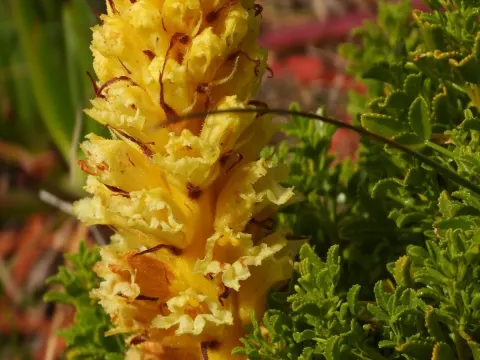
Orobanche densiflora
Orobanche densiflora
Orobanche densiflora is an obligate root parasite belonging to the Orobanchaceae family. As a holoparasite, it lacks chlorophyll completely and depends entirely on a host plant for its water and nutrient requirements.
What the section contains
Orobanche densiflora
This species is native to arid and semi-arid Eurasian regions. Its distribution is strongly correlated with the presence of host plants, particularly within the Fabaceae (legume) family, such as alfalfa and various wild pulse species.
The environmental requirements for Orobanche densiflora include well-drained soils and warm temperatures. These conditions are critical for both the host plant growth and the germination of parasitic seeds, which require specific chemical triggers from host roots.
Botanically, the plant features a fleshy, erect stem covered in scales, terminating in a dense, spike-like inflorescence. Its root system is replaced by a specialized haustorium that penetrates the host's vascular tissues to extract resources.
There is no positive agricultural use for this plant; it is considered a severe agricultural weed. Infestations lead to stunted crop growth, significant yield reduction, and, in severe cases, the complete collapse of the infected crop field.
Orobanche densiflora acts as a primary biotic stressor. Its presence compromises the integrity of the host plant, often making the crops more susceptible to secondary fungal or bacterial pathogens due to weakened immunity.
Management strategies focus on strict phytosanitary measures. This includes ensuring the purity of sowing seeds and avoiding the movement of contaminated soil from infested areas to clean fields.
Crop rotation is the most reliable method for controlling the population. By planting non-host species for several years, the seed bank of Orobanche in the soil can be significantly depleted, preventing germination cycles.
Chemical control is challenging and generally ineffective because the parasite is biologically integrated with the crop's vascular system. Any chemical strong enough to destroy the parasite often risks damaging the host crop as well.
Biological control research explores the use of specialized insects and soil fungi (mycoherbicides) that naturally parasitize Orobanche stalks or seeds, providing a sustainable way to suppress the spread of this parasitic threat.