
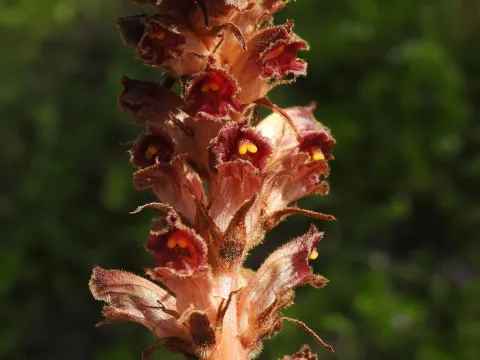
Slender broomrape
Orobanche gracilis
Slender broomrape (Orobanche gracilis) is a member of the Orobanchaceae family, recognized as an obligate root parasite. As a holoparasite, it lacks chlorophyll and relies entirely on host plants for water, minerals, and carbohydrates.
What the section contains
Slender broomrape
The distribution of this species covers diverse regions, particularly in Central and Southern Europe and parts of the Mediterranean. It thrives in environments where host leguminous plants are readily available to support its growth.
Environmentally, this plant requires specific chemical signals from the roots of a host to trigger seed germination. Once germinated, the seedling must rapidly attach to a host root to survive; otherwise, it will perish within a few days.
Botanically, it appears as an erect, fleshy stem emerging from the soil. The vegetative part is often reddish or yellowish, characterized by reduced scale-like leaves rather than true foliage. Its reproductive capacity is immense, with a single plant producing thousands of microscopic seeds.
While not a crop, it is of great economic concern. It severely competes with legumes for nutrients, leading to stunted growth, wilting, and in heavy infestations, total failure of the agricultural crop.
Controlling Orobanche gracilis remains a significant challenge for modern agriculture. The primary strategy involves depleting the soil seed bank by utilizing trap crops that trigger germination without allowing the parasite to thrive.
Biological control agents, specifically the fly Phytomyza orobanchia, serve as natural limiting factors. These insects lay eggs inside the broomrape flowers, and the developing larvae consume the internal tissues and seeds, suppressing further spread.
Agronomic control involves deep plowing to bury seeds, although their long-term viability in the soil limits the effectiveness of this method. Crop rotation remains the cornerstone of management strategies to maintain yield levels.
Prevention is vital, as the seeds are easily transported via contaminated soil, machinery, and agricultural tools. Strict quarantine and phytosanitary measures are essential to prevent the spread of this parasitic threat to clean fields.
- Extended crop rotation sequences.
- Use of resistant legume varieties.
- Strategic chemical control with selective herbicides.
- Monitoring fields for early signs of broomrape emergence.