
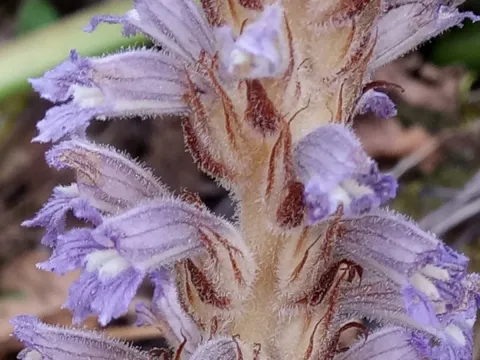
Schultz's broomrape
Orobanche schultzii
Schultz's broomrape (Orobanche schultzii) is an obligate root parasite belonging to the Orobanchaceae family. As a holoparasitic plant, it lacks chlorophyll and cannot perform photosynthesis, obtaining all its necessary water, minerals, and carbon compounds directly from the vascular system of its host plants.
What the section contains
Schultz's broomrape
From an agronomic perspective, this plant is categorized as a noxious weed rather than a crop. It occurs primarily in arid and semi-arid environments, where it parasitizes species within the Asteraceae and Fabaceae families, exerting severe physiological pressure on the host and significantly reducing crop yields in agricultural settings.
The morphology of the plant consists of a simple, unbranched stem, usually 10–30 cm tall, covered in scale-like leaves. Its inflorescence is a dense spike featuring yellowish-brown to violet flowers. This unique floral structure allows for precise identification in the field, which is critical for early detection and mitigation.
The plant's environmental requirements are tightly aligned with arid zones. It thrives in well-drained, sandy or gravelly soils where seasonal temperature fluctuations trigger the germination of its microscopic seeds. The survival strategy relies on the detection of specific root exudates from host plants to initiate the growth cycle.
The lifecycle of this broomrape is highly specialized, allowing it to persist in the soil for many years. Because the seeds remain dormant until exposed to host-specific chemical signals, infestations can be difficult to eliminate entirely from fields once the soil bank is contaminated with seed material.
The primary threat posed by Orobanche schultzii is the direct withdrawal of nutrients and water from host crops. This parasitism manifests as stunted plant development, chlorosis, and significantly reduced biomass, which translates into substantial economic losses for farmers if the infestation is not managed early.
Effective management strategies focus on crop rotation and the use of trap crops, which trigger germination of the broomrape seeds without allowing the parasite to establish a successful connection. This "suicidal germination" technique is a cornerstone of integrated weed management in infested areas.
Biological control efforts are also under investigation, focusing on insects that target the flower stalks and seed capsules of the parasite. By reducing the seed production of the broomrape, these natural enemies help lower the pressure on subsequent crop cycles and minimize the spread of the infestation.
Chemical control remains complex due to the close physiological connection between the parasite and the host plant. Selective herbicides are often used with caution, requiring specific application windows that target the parasite during its initial penetration phase without damaging the primary crop species.
Fungal pathogens represent significant threats to the broomrape itself. Infections caused by various soil-borne fungi can effectively rot the stem of the parasite, particularly during periods of high humidity or excessive moisture, which creates a natural suppression mechanism within the local plant community.