
Common broomrape
Orobanche minor Sm.
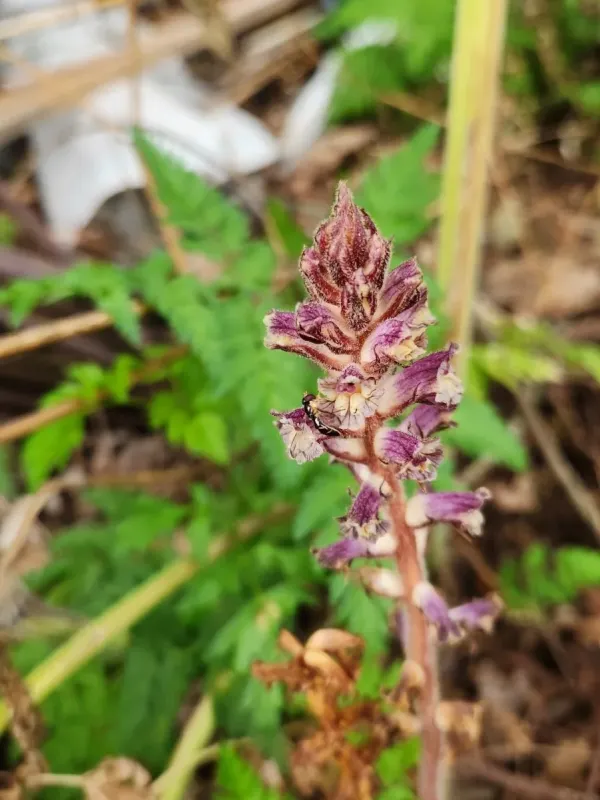
Description
Growing requirements
Common broomrape (Orobanche minor) is a member of the Orobanchaceae family. It is an obligate holoparasite, meaning it completely lacks chlorophyll and must attach to the roots of a host plant to obtain water and carbohydrates.
The species is native to the Mediterranean region but has established itself across various continents, including Europe, North America, and parts of Asia, frequently colonizing agricultural fields where suitable host plants are present.
The plant grows as an erect, fleshy stem, typically brown or yellow in appearance. It produces a spike-like inflorescence bearing numerous tubular flowers that are pollinated by insects, leading to the production of thousands of dust-like seeds.
Its germination is triggered by chemical exudates released from the host plant's roots in the soil. Favorable conditions for emergence include moderate soil temperatures and adequate moisture levels during the early growth stage of the host crop.
Agricultural management requires rigorous sanitation practices. Seed certification is essential to prevent the contamination of fields with broomrape seeds, which are easily transported via contaminated machinery and crop harvest materials.
Main diseases and pests
This parasitic weed severely impacts a variety of legume crops such as clover and alfalfa, as well as tobacco and various vegetable species. Heavy infestation leads to significant yield losses and sometimes total crop failure due to nutrient depletion.
The persistence of the seed bank is a primary challenge, as seeds remain viable in the soil for over a decade. This longevity makes eradication extremely difficult even after years of rotation with non-host plants.
Integrated management includes the use of herbicides targeting the parasite during its development, combined with the selection of resistant cultivars where breeding programs have successfully identified traits that prevent parasite attachment.
Biological control efforts often explore natural enemies like Phytomyza orobanchia, a fly species that larvae feed on the developing pods and seeds of the broomrape, significantly reducing the reproductive output.
- Monitor soil health and weed density.
- Implement strict field sanitation.
- Utilize resistant crop varieties.
- Adopt long-term crop rotation cycles.