
Nodding broomrape
Orobanche cernua Loefl.
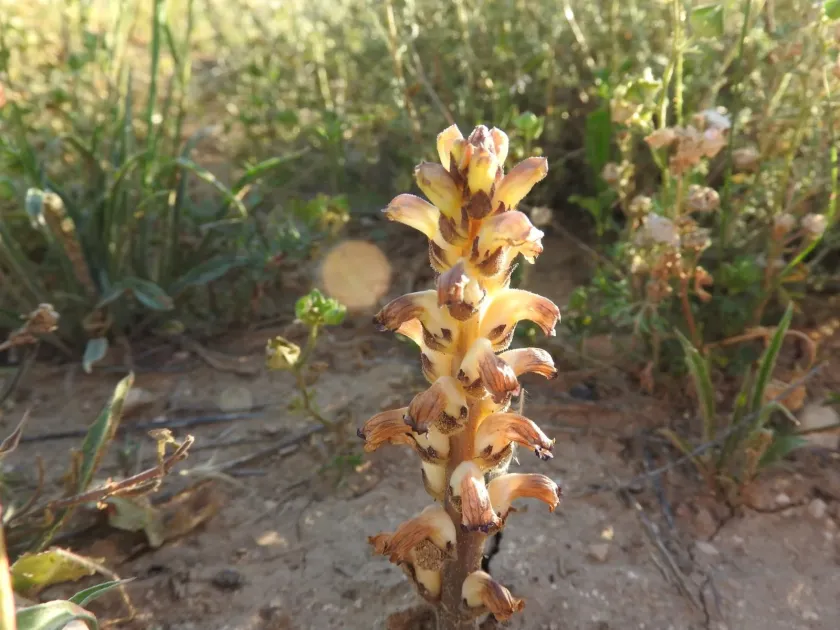
Description
Growing requirements
Nodding broomrape (Orobanche cernua Loefl.) is a specialized root parasitic plant belonging to the Orobanchaceae family. As an obligate parasite, it has no photosynthetic capacity and depends entirely on the host plant for water, minerals, and carbohydrates.
The geographical range of this species is extensive, covering arid and semi-arid regions of Asia, Southern Europe, and North Africa. It flourishes in soils that are conducive to host plant root growth, specifically where host plants like sunflowers are cultivated intensively.
Botanically, the plant is characterized by a fleshy, yellowish or brownish stem with scale-like leaves. The inflorescence is a dense, terminal spike that typically bends downward at the tip, hence the common name "nodding" broomrape.
The plant requires specific root exudates (strigolactones) from a host plant to trigger the germination of its microscopic seeds. Without these chemical signals, the seeds can remain dormant in the soil for over a decade, awaiting a suitable host.
Agronomically, this plant is considered a severe threat to food security and farm profitability. Infestation can lead to total crop failure, as the parasite develops subterranean haustoria that tap directly into the host plant's vascular tissue.
Main diseases and pests
The primary economic hosts are members of the Asteraceae family, most notably sunflowers, as well as Solanaceae crops like tomatoes and tobacco. Infested plants show signs of severe stunted growth, chlorosis, and significantly reduced yield potential.
Integrated weed management is the standard approach to mitigating broomrape damage. This includes utilizing resistant crop varieties that can detect the parasite's root attachment and activate localized cell death to prevent the connection from forming.
Crop rotation is essential for long-term management. By planting "trap crops" that induce seed germination without allowing the parasite to attach, farmers can effectively deplete the seed bank within the soil over several years.
Chemical control involving herbicides, specifically the imidazolinone group in herbicide-tolerant sunflower hybrids, provides effective post-emergence control. This requires precise timing to hit the parasite during its early developmental stage.
Biological control methods are also being researched, particularly the introduction of the broomrape fly (Phytomyza orobanchia). This insect acts as a natural control agent by laying eggs in the broomrape flowers, with larvae destroying the seeds and preventing spread.