
Crenate broomrape
Orobanche crenata Forssk.
Description
Growing requirements
Crenate broomrape (Orobanche crenata) is a parasitic plant within the Orobanchaceae family. As a holoparasite, it lacks chlorophyll and relies exclusively on host plants, primarily legumes, to derive water, minerals, and essential photosynthetic products for survival.
Originating from the Mediterranean basin and the Middle East, this plant thrives in temperate to warm climates. It is highly adapted to calcareous soils and poses a severe threat to crops such as faba beans, peas, and lentils, causing significant yield losses in affected areas.
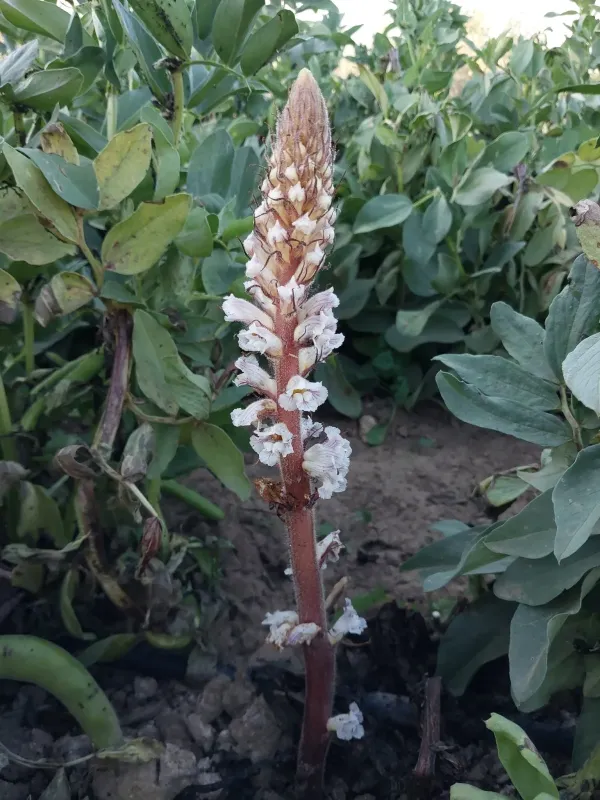
The morphology consists of a fleshy, unbranched stalk ranging from 20 to 60 cm in height. The inflorescence is a dense spike of white to light violet flowers. The plant produces a massive amount of tiny seeds, which are disseminated primarily by wind and irrigation water.
The lifecycle begins with the germination of seeds in response to chemical signals known as strigolactones, which are exuded by the roots of host plants. This highly specific interaction ensures that the parasite germinates only in the presence of an appropriate food source.
Cultural control is key to managing this pest. Strategies include the use of trap crops, which trigger suicidal germination of the broomrape seeds without providing a host, and the implementation of long-term crop rotation cycles to deplete the soil seed bank.
Main diseases and pests
The primary impact of Orobanche crenata is the severe physical depletion of the host plant. By attaching to the vascular system of the legume roots, it competes for resources, often leading to stunted growth, reduced pod formation, and eventually plant mortality.
Beyond resource competition, the parasite acts as a vector for various plant viruses. When the parasite's haustoria connect with the host's root system, it creates a conduit that facilitates the rapid transmission of systemic viral diseases across the field.
The longevity of seeds in the soil is a major hurdle for eradication. The seeds can remain dormant for over a decade, requiring farmers to manage infected land with extreme caution to prevent the spread to adjacent plots via contaminated machinery.
Although specific biological control agents are under research, the use of systemic herbicides and resistant cultivars remains the most reliable strategy. However, the development of broomrape-resistant faba bean lines is still a work in progress for many breeding programs.
Economic losses are cumulative, as each cycle of uncontrolled parasitism leads to an exponential increase in the seed bank, eventually forcing farmers to abandon the cultivation of susceptible pulses in heavily infested regions.