
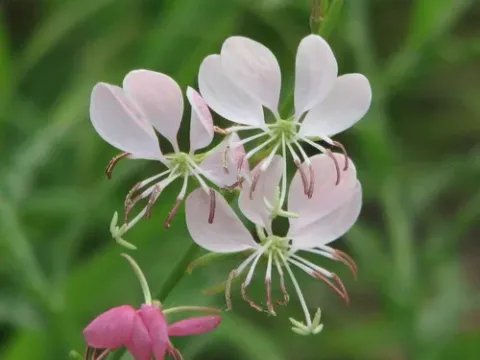
Evening primrose
Oenothera hispida
Evening primrose (Oenothera hispida) belongs to the Onagraceae family. In agricultural production, sowing is typically performed either in late autumn or early spring, as soon as the soil temperatures reach at least 8–10 degrees Celsius.
What the section contains
Evening primrose
The seeds of this crop are extremely small, necessitating precise preparation of the seedbed. They should be sown shallowly, at a depth of no more than 0.5 to 1 centimeter, to ensure emergence.
For spring planting, adequate moisture is critical. After sowing, light rolling is recommended to establish good seed-to-soil contact, which accelerates germination and promotes more uniform crop stands.
Row spacing is generally maintained at 45–60 centimeters to facilitate mechanical weed control. Since the seedlings grow slowly in the early stages, ensuring a clean field before sowing is highly essential.
The seeding rate ranges between 2 to 4 kilograms per hectare, depending on seed quality and germination rate, aiming to achieve an optimal population density for the specific soil type and climatic zone.
This crop is highly light-demanding, thriving best in open fields with full exposure to sunlight. Shading or competition from weeds can drastically reduce both vegetative development and seed quality.
Ideal soil conditions include light, well-drained sandy loams with a neutral or slightly acidic pH. Poorly drained soils that tend to waterlog should be avoided as they increase the risk of root rot.
While the plant is moderately drought-tolerant, consistent moisture availability during the flowering and seed-filling stages is necessary to achieve maximum potential yield and high oil content.
A well-prepared seedbed free of perennial weeds is crucial, as the slow initial growth of evening primrose makes it highly susceptible to competition during the first weeks of the growing season.
The plant performs best in temperate climates with daytime temperatures between 18 and 25 degrees Celsius. It exhibits good winter hardiness if properly established before the onset of frost.
The yield of Oenothera hispida is largely measured by its seed production, which is rich in gamma-linolenic acid (GLA). Under optimal management, seed yields can reach between 0.5 and 1.5 tonnes per hectare.
Harvesting timing is critical because the seeds mature unevenly within the capsules. Producers often use desiccants a few days prior to harvest to promote uniform drying and reduce shattering losses.
Combine harvesting requires careful adjustment of air settings due to the small, lightweight nature of the seeds. Modern equipment must be cleaned thoroughly to prevent seed loss during the threshing process.
Once harvested, the seeds must be immediately cleaned and dried to a moisture content of 8–10 percent. High moisture levels in storage can lead to rapid deterioration of oil quality and seed viability.
Beyond seed oil production, the biomass can sometimes be processed for secondary compounds, depending on the specific industrial demand and the extraction technology available to the processor.
Powdery mildew is a common fungal threat to evening primrose, especially in dense stands with high humidity. Proper field ventilation and balanced nutrient management help to mitigate this risk.
Pests such as aphids and various lepidopteran larvae can damage the foliage and developing buds. Integrated pest management strategies, including regular field scouting, are essential for successful production.
Root rot diseases are primarily associated with saturated, heavy soils or poor field drainage. Preventing water accumulation is the most effective cultural method to manage soil-borne pathogens.
Seed-feeding insects can cause damage during the maturation phase within the seed capsules. Maintaining distance from wild host plants helps reduce the influx of these pests into the field.
Early-season weed control is vital, as evening primrose is a poor competitor when young. Mechanical weeding between rows should be performed carefully to avoid damaging the shallow root system.