
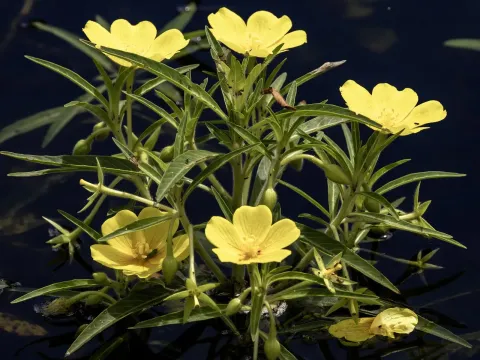
Ludwigia hexapetala
Ludwigia hexapetala
Ludwigia hexapetala, commonly known as the creeping water primrose, is an invasive perennial aquatic plant belonging to the Onagraceae family. Originating from South America, this species has successfully colonized diverse wetland ecosystems worldwide, including rivers, lakes, and irrigation ditches.
What the section contains
Ludwigia hexapetala
The plant exhibits remarkable adaptability, thriving in both submerged and emergent forms. It forms dense, floating mats that cover large surface areas, which significantly disrupts the ecological balance of the water body by shading out native submerged aquatic vegetation.
Requirements for growth include nutrient-rich, stagnant or slow-moving water, and plenty of sunlight. It is highly efficient at extracting nutrients from the water column through its adventitious roots, which often leads to rapid, unchecked biomass accumulation in eutrophic waters.
Botanically, Ludwigia hexapetala is characterized by hairy leaves and bright yellow flowers with six petals, which distinguishes it from related species. The stems are capable of producing roots at each node, facilitating rapid vegetative propagation across the water surface.
Managing this plant is considered a priority in many countries due to its potential to alter hydrology and negatively impact biodiversity. It is not cultivated for agricultural purposes; instead, it is classified as a significant weed that disrupts infrastructure and ecosystem services.
The primary threat posed by Ludwigia hexapetala is the obstruction of water flow in irrigation canals and flood control channels. By creating thick, interconnected mats, the plant restricts flow, promotes siltation, and requires frequent and costly manual or mechanical clearance.
The accumulation of massive amounts of decomposing organic matter when the plant dies causes significant oxygen depletion in the water column. This phenomenon, known as hypoxia, leads to mass fish kills and disrupts the entire aquatic food web within the affected water bodies.
There are very few natural pests or diseases that effectively control the spread of this species in new habitats. Because it is an introduced invasive, its natural enemies from its native range are absent, allowing it to grow without the biological checks that regulate its population size.
Control efforts are further complicated by the plant's high regenerative capacity. Fragments of the stem can drift downstream, root in new sediment, and establish entire new colonies, making eradication extremely difficult once the plant is introduced into a river system.
Current management strategies are limited to localized physical removal and highly selective herbicide application. Due to the high sensitivity of aquatic ecosystems, finding a balance between eliminating the invasive weed and preserving water quality remains a critical challenge for environmentalists.