
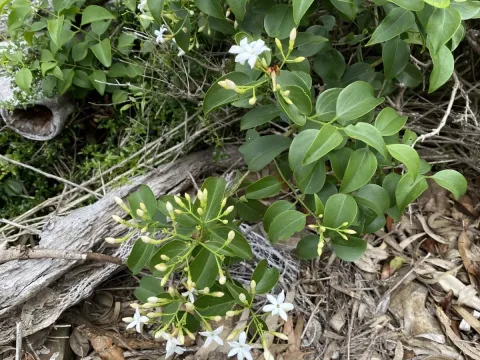
Stiff jasmine
Jasminum volubile
Stiff jasmine (Jasminum volubile) is a woody, evergreen climbing plant belonging to the Oleaceae family. Native to the rainforests and coastal areas of eastern Australia, it is prized for its glossy foliage and fragrant star-shaped flowers.
What the section contains
Stiff jasmine
This climber thrives in full sun to partial shade. When grown in containers or gardens, it requires a position where it can receive bright light for several hours, which promotes more intense flowering and healthy leaf production.
The plant demands well-draining, fertile, and slightly acidic to neutral soil. In containers, a high-quality potting mix enriched with compost or peat moss is essential to maintain the moisture levels while preventing waterlogging.
Climatic requirements are focused on warmth and frost protection. While it can withstand light frosts for short periods once mature, it generally prefers temperatures above 10 degrees Celsius and requires protection from harsh, drying winds.
Regular maintenance involves installing strong trellises or supports, as the stems are naturally vigorous and need guidance. Pruning is necessary after the flowering period to encourage branching and maintain the desired shape and size.
Spider mites are the most notorious pests affecting Stiff jasmine, particularly in greenhouse or indoor environments where humidity levels are low. They cause stippling and discolouration on the foliage.
Scale insects can attach themselves to the stems and leaves, extracting plant sap and weakening the vine. Manual removal or the application of horticultural oils is an effective control measure for localized infestations.
Root rot is a major threat caused by over-irrigation or poorly structured, heavy soil. Symptoms include wilting and leaf drop even when the soil appears moist, requiring immediate attention to soil aeration.
Powdery mildew may occur when air circulation is poor, appearing as a white powdery coating on leaves. Ensuring adequate spacing between plants and trimming excess growth helps mitigate this issue significantly.
Aphids can occasionally target the soft tips of new growth. Monitoring during spring growth spurts is recommended, with insecticidal soaps used as a safe, effective control option for young shoots.