
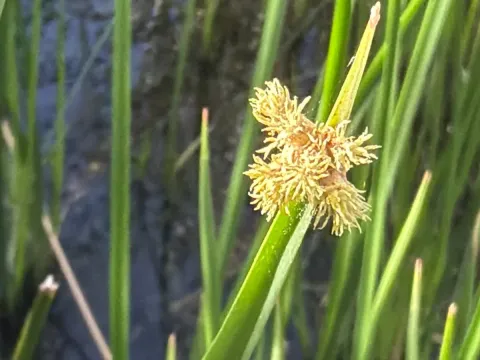
Olney's bulrush
Scirpus olneyi
Olney's bulrush (Scirpus olneyi), often identified as Schoenoplectus americanus, is a perennial sedge widely distributed in brackish marshes and coastal wetlands.
What the section contains
Olney's bulrush
Propagation is primarily achieved through vegetative growth, where robust rhizomes spread through the substrate to form dense colonies in suitable habitats.
Seed germination is less common in wild populations and typically requires fluctuating water levels and specific temperature conditions to trigger development.
For restoration projects, planting rhizome plugs in the spring is the most effective method to ensure the establishment of the population before the growing season peak.
Proper spacing and depth are essential during planting to ensure the roots remain anchored while having access to the necessary moisture levels for immediate growth.
This species is highly adapted to high-salinity environments, making it a dominant plant in coastal marshes where other freshwater species fail to establish.
Full sunlight is a critical requirement for Olney's bulrush, as it cannot thrive under a canopy of trees or in shaded wetland areas.
The substrate should consist of saturated, nutrient-rich soils that support the development of extensive rhizome systems, often found in tidal or marshy conditions.
Consistent water levels are vital; however, the plant shows some tolerance to temporary shifts in depth, provided the root zone remains consistently hydrated.
Temperature fluctuations are usually managed by the water body itself, but extremely cold winters can impact the plant's health in the northernmost parts of its range.
The biomass production of Olney's bulrush serves as a vital food source for waterfowl, muskrats, and other wildlife dependent on healthy coastal ecosystems.
Its nutritional value and abundance make it a preferred species in marsh management programs designed to support diverse wildlife populations.
Yield estimation is typically based on the coverage density per hectare, which can be significant when environmental conditions are managed to favor the species.
As a sustainable resource, the annual production is balanced by the natural cycle of the marsh, preventing overgrazing by local fauna while maintaining ecological health.
The species contributes significantly to the organic structure of the wetland, helping to stabilize the soil and prevent coastal erosion through its dense root architecture.
Hydroperiod changes, particularly the permanent lowering of water levels, pose the greatest threat to established Olney's bulrush populations.
Fungal infections can occur if the water becomes stagnant, leading to decay in the rhizome system and weakening the plant's overall structural integrity.
Invasive plant species are a constant challenge, as they can outcompete the bulrush in areas where the salt balance of the soil has been modified by pollution or runoff.
Excessive herbivory by wild populations, while a sign of a healthy ecosystem, can reach unsustainable levels if the marsh area is restricted or fragmented.
Agricultural runoff containing herbicides or heavy metals can accumulate in the plant tissues, reducing its suitability as a food source for local wildlife.
Mechanical harvesting must be conducted with extreme caution to protect the fragile wetland soil structure and the underlying rhizome mass.
The timing of the harvest is critical and should coincide with the period when nutrient levels are optimal, usually avoiding the primary nesting season for local birds.
Low-ground-pressure equipment is necessary to minimize disturbance to the marsh floor during the collection of biomass for conservation or restoration use.
Drying procedures are essential after harvesting to ensure the biomass does not develop mold or lose its nutritional profile during storage.
Post-harvest management often includes leaving a percentage of the standing crop to maintain cover for small animals and to facilitate vegetative regeneration in the next cycle.