
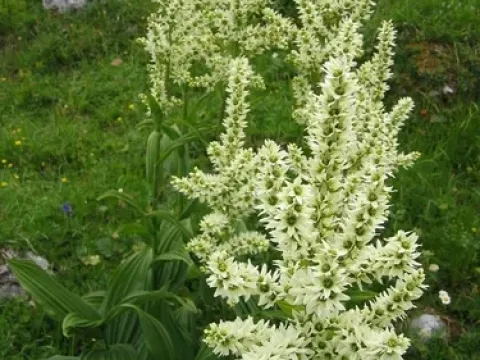
White hellebore
Veratrum album
Veratrum album is typically propagated through seeds or by division of the rhizomes. Seeds require a long period of cold stratification, making late autumn the ideal time for sowing directly into the soil.
What the section contains
White hellebore
Germination is often slow and erratic. For successful establishment, it is essential to keep the seedbed consistently moist and provide a high-quality organic growing medium.
Vegetative propagation via rhizome division is generally more reliable. This process should be undertaken in early spring before the start of the growing season or in late summer after flowering.
Each division must include at least one healthy dormant bud. Ensuring proper spacing is crucial for long-term productivity, typically around 50–60 centimeters between plants.
The plant is a member of the Melanthiaceae family and is known for its slow growth rate, requiring patience from the grower during the establishment phase.
White hellebore thrives in deep, humus-rich, and consistently moist soils. A neutral to slightly acidic pH is considered optimal for the healthy development of its root system.
The selection of an appropriate site is critical, with partial shade being the most favorable condition. Intense direct sunlight can lead to scorched leaves and overall decline in plant vigor.
The plant is native to mountain regions and forests, meaning it prefers cool temperatures and high humidity levels. In warmer climates, irrigation is mandatory for survival.
It is a hardy perennial, capable of surviving harsh winters because its extensive rhizome system remains well-protected beneath the surface of the soil.
Regular maintenance, including organic mulching, helps retain soil moisture and suppresses weed growth, which is essential as the plant is sensitive to competition.
The most common pests include various leaf-eating beetles and fly larvae that can significantly damage the foliage, reducing the plant's photosynthetic capacity.
Root rot is the primary disease threat, typically caused by excessive water retention or poor drainage. Maintaining good soil structure is the best preventative measure.
Powdery mildew can affect the leaves during periods of high humidity and fluctuating temperatures. Ensuring adequate air circulation around the plants can mitigate this risk.
Effective management requires regular scouting of the plantation. Due to the inherent toxicity of the plant, chemical control should be handled with extreme care.
Preventative cultural practices, such as removing debris and avoiding overcrowding, are more sustainable than relying solely on pesticides to protect the crop.
The harvest focuses on the rhizomes, which are typically collected in late autumn after the foliage has died back or in early spring before new growth begins.
Rhizomes are carefully excavated, ensuring they are not sliced or damaged during the process. The collected roots are then thoroughly washed to remove all soil particles.
After washing, the rhizomes are trimmed, cut into manageable pieces, and dried in controlled conditions to ensure proper preservation of active compounds.
Drying is performed in ventilated areas or specialized drying chambers at temperatures between 40 and 50 degrees Celsius to prevent degradation.
The final product must be stored in dry, cool conditions away from moisture, as the dried rhizomes are highly hygroscopic and susceptible to mold if stored improperly.