
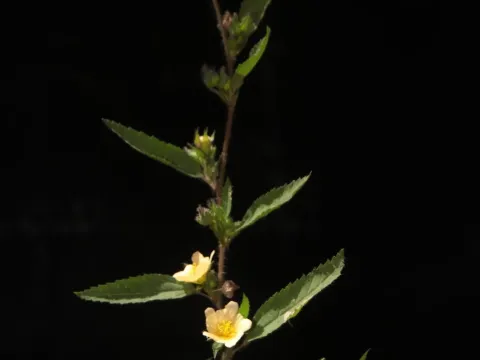
Sida hirsutissima
Sida hirsutissima
Sida hirsutissima is a heat-loving crop, requiring soil temperatures to reach at least 15-18 degrees Celsius for successful germination of the seeds.
What the section contains
Sida hirsutissima
The ideal sowing window typically opens in late spring, once all risks of frost have passed and soil conditions remain consistently warm.
Moisture at the time of planting is crucial; therefore, farmers are advised to sow immediately after field preparation to preserve existing soil water.
A row spacing of 30 to 45 centimeters is recommended to balance plant density, optimize light interception, and allow for efficient mechanical weeding.
The seeding rate must be adjusted based on the specific seed quality to ensure a uniform stand that provides maximum biomass output per hectare.
Belonging to the Malvaceae family, this plant is highly demanding regarding thermal conditions throughout its entire vegetative development period.
It performs best in fertile, well-structured loam or sandy-loam soils that have a neutral to slightly acidic pH level to support healthy growth.
Exposure to direct sunlight is essential for this species; therefore, fields must be situated in open areas free from shade provided by trees or structures.
While the plant requires sufficient moisture for vigorous growth during the stem-elongation phase, it strictly avoids waterlogged soil conditions.
Good drainage is a prerequisite, as Sida hirsutissima is susceptible to root stress if subjected to prolonged periods of standing water in the root zone.
Yield potential in Sida hirsutissima is highly influenced by consistent field management and the adequacy of available nutrients during the growing season.
When cultivated under optimal conditions, the dry stem mass can produce significant yields, making it a viable candidate for various industrial fibers.
The fiber extraction rate from the stems typically falls between 15 and 20 percent, depending on the harvest stage and the specific processing techniques utilized.
Strategic application of nitrogen-based fertilizers during the active growth phases can substantially enhance the final biomass accumulation.
Uniformity in the crop stand is the key to maximizing harvest results, which highlights the importance of precise planting and early-stage maintenance.
Weed management during the initial growth stages is critical, as competing vegetation can easily overwhelm young Sida hirsutissima seedlings.
Entomological threats often involve various leaf-feeding beetles, such as weevils, which may reduce the plant's photosynthetic capacity if left unchecked.
High humidity and poor air circulation in the canopy can promote fungal infections, including powdery mildew and various leaf spot pathogens.
Root rots represent a significant threat if proper crop rotation practices are neglected, leading to a buildup of soil-borne pathogens over time.
Farmers should implement integrated pest management (IPM) strategies, combining cultural practices with targeted treatments when necessary to protect the yield.
Harvesting should be timed to coincide with the early flowering phase to achieve the highest quality of fiber before the stems become overly lignified.
The stems are typically cut and left to dry in the field, a process that simplifies the separation of the inner fiber from the woody core.
Mechanized equipment is highly recommended to streamline the harvesting process, reduce manual labor requirements, and minimize potential crop losses.
Following the harvest, the material is usually baled and transported to processing facilities to prevent fiber degradation due to moisture exposure.
Post-harvest management involves clearing field residues through deep tillage, which helps in breaking pest life cycles and maintaining overall soil structure.