
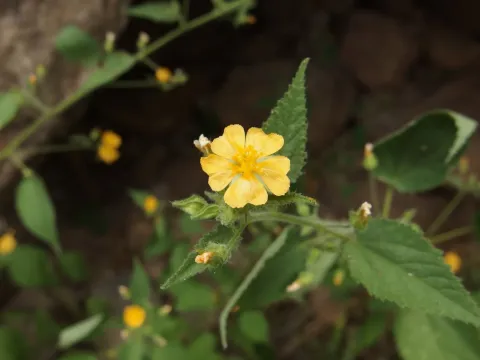
Sida glabra
Sida glabra
Sida glabra is a warm-season crop, requiring well-warmed soil to initiate germination, typically performed during mid-spring when frost risks have passed.
What the section contains
Sida glabra
Seeds should be planted at a shallow depth of 2–3 centimeters to ensure optimal moisture contact and sufficient heat for uniform seedling emergence.
Row spacing is generally managed at 45–60 centimeters to facilitate mechanical weeding, which is essential during the plant's slow initial growth phase.
Ensuring a stable soil temperature of at least 15 degrees Celsius is crucial for accelerating early development and establishing a robust root system.
Seedbed preparation requires careful cultivation to remove existing weeds, as Sida glabra exhibits slow establishment vigor during its first months.
As a member of the Malvaceae family, Sida glabra thrives in sunny, well-lit environments with fertile, well-drained loamy or sandy soil types.
The plant demonstrates good adaptability to diverse soil conditions but requires proper aeration to prevent root rot in heavier soil structures.
Originating from warmer climates, this species requires a long growing season with high heat accumulation to reach its full vegetative potential.
While somewhat drought-tolerant once established, it requires regular precipitation or irrigation during the critical stem elongation phase for optimal yield.
Neutral pH levels are ideal for nutrient uptake, and maintaining soil fertility through organic or mineral fertilizers supports vigorous long-term growth.
Sida glabra is primarily recognized for its potential as a forage crop, offering a high-protein green biomass suitable for various livestock feeds.
The fibrous nature of the plant stems also allows it to be considered for niche industrial applications, provided the processing technology is available.
Under favorable agronomic conditions, the crop provides consistent annual yields of biomass, contributing to the productivity of sustainable farming systems.
Harvesting strategies focused on biomass accumulation at the early flowering stage maximize the nutrient density of the final product.
By implementing proper fertilization and weed management, growers can significantly increase the total dry matter production per hectare over multiple seasons.
Common pests associated with this plant include aphids and spider mites, which can cause significant damage during hot and dry growing periods.
Fungal pathogens such as leaf spot or powdery mildew may occur if planting density is too high or if air circulation remains insufficient within the crop canopy.
Weed competition remains the primary challenge in the first year of production, necessitating diligent monitoring and timely mechanical control measures.
Integrated Pest Management (IPM) practices, including crop rotation and the use of targeted biological controls, are recommended to minimize chemical reliance.
Preventative actions, such as removing crop residues after harvest and maintaining healthy soil nutrition, help suppress the prevalence of common diseases.
The optimal harvest window for forage production occurs at the onset of flowering, ensuring the best balance between biomass volume and nutritional content.
Seed harvesting should be timed precisely when the seed pods reach maturity to prevent yield losses through shattering or excessive desiccation.
Maintaining a cutting height of approximately 10–15 centimeters is vital for promoting healthy regrowth and ensuring the survival of the plant for future seasons.
Post-harvest handling requires quick processing to preserve the quality of the green mass and prevent the degradation of essential feed nutrients.
Efficient machinery adjustment during harvest ensures that stem integrity is preserved and minimizes leaf loss, which holds a significant share of the plant's nutrients.