
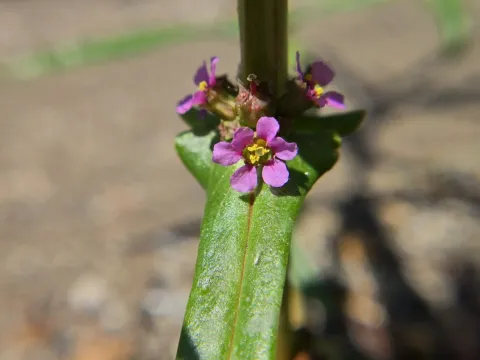
Ammannia coccinea
Ammannia coccinea
Ammannia coccinea is an annual herbaceous weed that primarily germinates from seeds deposited in the soil surface layers during the preceding seasons.
What the section contains
Ammannia coccinea
Germination typically occurs when the soil temperature increases significantly, coinciding with the early stages of the rice planting season in flooded environments.
Seedlings emerge in waves, which is a survival strategy that allows the plant to persist in agricultural fields despite initial control attempts by farmers.
The seeds possess a high degree of adaptability to waterlogged conditions, allowing them to remain dormant for short periods before initiating growth once flooding is established.
Optimal environmental cues for mass germination involve both high humidity and stable warm temperatures, which are characteristic of the primary cultivation regions for this species.
Belonging to the Lythraceae family, this species is a true hydrophyte that thrives in areas with permanent or seasonal shallow standing water, such as rice paddies.
Ammannia coccinea requires moist or water-saturated soil conditions to complete its life cycle and is rarely found in upland fields lacking sufficient hydration.
The plant is highly sunlight-demanding; it does not compete well in shaded areas, making it most aggressive in open field conditions where direct radiation reaches the canopy.
While it can tolerate a variety of soil types, it shows a strong preference for fertile silty clays that are high in organic matter and retain moisture effectively.
The species exhibits a wide climatic adaptability but favors tropical and subtropical regimes where the temperature rarely drops significantly during the vegetative phase.
The primary threat posed by Ammannia coccinea is its status as a highly competitive weed in rice ecosystems, where it rapidly monopolizes nutrient uptake.
It exerts significant allelopathic effects or simple physical competition that leads to stunted growth in neighboring rice plants and reduced overall harvest density.
There are few natural pathogens that effectively keep this species in check, as it has evolved robust resistance to many common environmental stressors in its habitat.
Management is often complicated by the plant's ability to survive in both fully submerged and moist soil conditions, limiting the effectiveness of traditional water-level manipulation.
Infestations are often spread through irrigation water, meaning that once established in a water source, the weed can migrate across entire agricultural networks.
Effective management and harvest-time control require the eradication of this species before it enters the flowering and seed-setting stages to prevent long-term soil contamination.
Harvesting rice in fields heavily infested with Ammannia coccinea requires careful cleaning of the grain to remove weed seeds, which can be difficult to separate due to size.
Mechanical control methods, such as cultivation or hand-weeding, are labor-intensive and often insufficient unless paired with systemic herbicide application at the seedling stage.
Post-harvest agricultural practices, including field plowing, are essential to bury the seed bank and reduce the potential germination rate for the following planting season.
Overall, a systematic approach involving crop rotation and chemical control is recommended to ensure the purity of the harvest and the longevity of field productivity.