
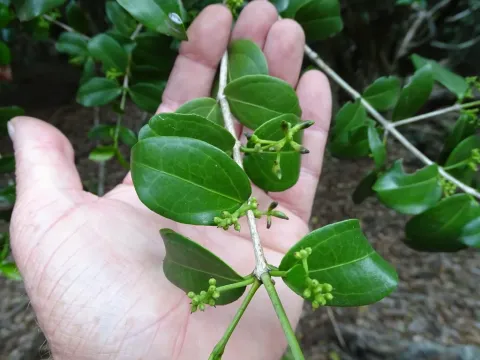
Strychnos henningsii
Strychnos henningsii
Strychnos henningsii is an evergreen tree belonging to the family Loganiaceae. Native to Southern and Eastern Africa, it typically grows in forest margins, woodlands, and scrublands, showcasing remarkable adaptation to various environmental conditions.
What the section contains
Strychnos henningsii
The plant thrives in well-drained, nutrient-rich soils. While it exhibits tolerance to varied soil compositions, successful cultivation requires consistent moisture management to prevent root rot in poorly draining environments.
Sunlight exposure is crucial for the development of this species. It performs best in full sun to partial shade, which encourages healthy leaf production and robust structural growth in its early years.
Climatic requirements favor tropical and subtropical regions. The species is highly sensitive to frost, necessitating protection or greenhouse cultivation in cooler climates to prevent physiological damage and tissue death.
General maintenance involves light pruning to manage the canopy structure and the application of organic mulch to improve soil structure and moisture retention around the base of the plant.
The harvesting of Strychnos henningsii is primarily focused on its bark and leaves, which contain a complex profile of alkaloids valued in traditional medical practices. Sustainable harvesting techniques are essential to ensure the longevity of the individual tree.
Bark collection is performed using minimal-impact methods, avoiding ring-barking which would lead to the tree's demise. Collectors typically select branches that are nearing the end of their peak metabolic cycle.
Post-harvest processing involves air-drying the collected bark in shaded, ventilated areas. This method preserves the chemical integrity of the active ingredients and prevents fungal degradation during storage.
The wood of the tree is recognized for its density and insect-resistant properties. It is often harvested locally for use in high-quality handicrafts, tools, and construction where durability is a primary requirement.
Quality control remains a critical aspect of harvest management. Proper sorting, cleaning, and storage are required to meet quality standards for any further use in local or international medicinal markets.