
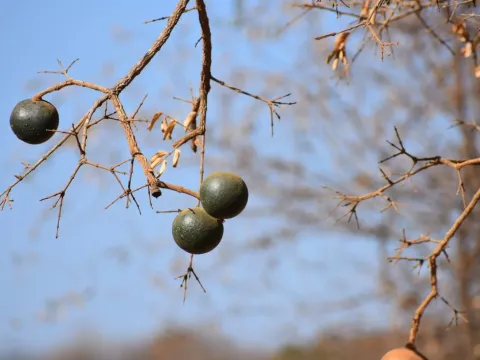
Strychnos cocculoides
Strychnos cocculoides
Strychnos cocculoides is a member of the Loganiaceae family, native to the savanna regions of Southern and Eastern Africa. It is a slow-growing deciduous or semi-evergreen tree that thrives in warm climates with distinct dry and rainy seasons.
What the section contains
Strychnos cocculoides
The plant demonstrates remarkable drought resistance, allowing it to survive in environments where other fruit species would perish. It prefers well-draining sandy or loamy soils and requires full sun exposure to reach its maximum productivity.
Agronomic management of this species involves minimal irrigation, as the tree is adapted to deep root growth. It does not require high levels of fertilization, though organic matter added during the early stages of development can accelerate growth.
Botanically, the tree is known for its sturdy structure and distinctive spherical fruits, often called monkey oranges. These fruits are protected by a thick, woody rind that makes them highly resistant to environmental stressors.
In addition to its culinary value, the tree plays a role in local ecology by providing shade and food for wildlife, making it an excellent candidate for agroforestry systems in semi-arid regions.
Harvesting Strychnos cocculoides requires identifying the optimal maturity stage. The fruits are ready when the outer shell changes color and the fruit emits a fragrant aroma, which usually occurs toward the end of the rainy season.
Manual harvesting is the preferred method, as the trees can be sensitive to aggressive mechanical handling. Pickers should carefully remove the fruits, ensuring that the fruit stalk is handled to prevent damage to the remaining branches.
Post-harvest shelf life is a significant advantage of this crop. Due to the hard shell, the fruits can be stored for several months at room temperature, which is a vital feature for small-scale farmers in remote areas.
Caution must be exercised during processing: while the pulp is delicious and nutritious, the seeds contain alkaloids and must be discarded safely to avoid potential toxicity issues.
Proper harvest practices contribute to tree health. After collection, it is recommended to prune any dead wood to ensure that the tree maintains its energy for the next year's crop cycle.