
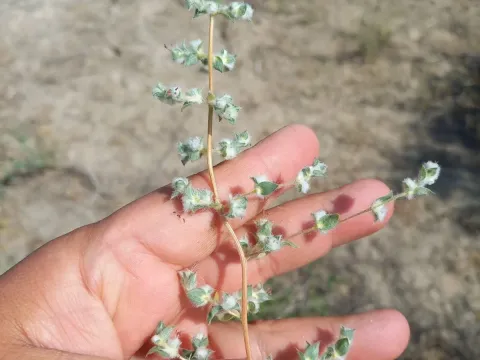
Londesia eriantha
Londesia eriantha
Londesia eriantha is an annual herbaceous plant belonging to the Amaranthaceae family. It is a highly specialized species adapted to survive in harsh arid environments, often found in desert and semi-desert regions of Central Asia.
What the section contains
Londesia eriantha
Sowing typically takes place in early spring, capitalizing on the soil moisture reserves left over from the winter season. The seeds require consistent but moderate moisture for germination, which is a critical phase for the establishment of the crop.
The planting depth should be shallow, generally between 1 and 2 centimeters, depending on the texture of the soil. Precise sowing depth ensures that the seedling emerges before the soil moisture is depleted by increasing temperatures.
Agricultural practice involves wide row spacing to prevent intraspecific competition. This strategy is essential in arid zones where water availability is the primary limiting factor for biomass production and final yield.
As an ephemeral plant, Londesia eriantha completes its life cycle relatively quickly. This biological strategy allows it to avoid the peak heat and drought of the summer months, making it a reliable crop in specific regional climates.
The crop thrives in well-drained, sandy, or loamy soils. It demonstrates a remarkable tolerance for soil salinity, making it an excellent candidate for agricultural use in degraded or saline desert landscapes.
As a xerophyte, Londesia eriantha has very low water requirements once the plants are established. Its physiological adaptations allow it to withstand significant drought stress without suffering from wilting or tissue necrosis.
The plant is extremely photophilous, requiring full sunlight to reach its maximum growth potential. Shading leads to stunted growth and reduced metabolic efficiency, so optimal site selection must ensure exposure to intense solar radiation.
Regarding soil fertility, the plant is undemanding and can perform well on nutrient-poor substrates. However, in systematic fodder production, modest applications of nitrogen fertilizers can significantly increase the total harvested green mass.
Temperature range is another critical factor; the species is adapted to wide diurnal temperature fluctuations. It remains productive even in conditions where night temperatures drop significantly below the daytime peaks typical of desert climates.
Pest pressure on Londesia eriantha is generally low due to the presence of secondary metabolites that act as natural defenses. Significant damage from common agricultural insects is rare, making it a low-input crop.
Fungal diseases are usually non-existent in the plant's native range. However, if grown in regions with high humidity and poor air circulation, powdery mildew or fungal root infections may potentially affect the crop's health.
Competition from invasive weeds can be a problem during the seedling stage. Once the plant achieves canopy closure, its rapid growth rate is usually sufficient to shade out and suppress most competing species in the surrounding area.
Rodent infestations can pose a localized risk, particularly during the early vegetative phase. Farmers should monitor fields adjacent to wild desert lands to prevent localized damage caused by burrowing animals during the planting season.
Proper field management, including the avoidance of compacted or waterlogged soils, is the most effective preventive measure against potential plant health issues. Maintaining good soil drainage is essential for long-term viability.