
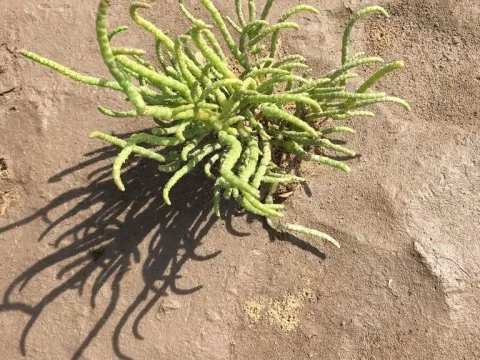
Long-spiked glasswort
Salicornia dolichostachya
The sowing of Salicornia dolichostachya is best performed during the spring season when soil temperatures become stable. Optimal timing usually falls between April and May, ensuring that the seedlings avoid late frost while benefiting from increasing sunlight levels.
What the section contains
Long-spiked glasswort
The seeds of this species are highly specialized for germination in saline environments. It is crucial to maintain adequate surface moisture after sowing, as even small amounts of soil drying can lead to the failure of young, tender seedlings to establish roots.
Standard agronomic practice involves surface broadcasting or very shallow placement of seeds. Because the seeds require light to germinate, covering them with a thick layer of soil significantly reduces the rate of emergence and overall stand density.
For commercial production, row planting is recommended to ensure uniform distribution and ease of management. Maintaining the correct density per square meter is essential for the crop to optimize resource intake from the saline substrate.
Monitoring the moisture content of the upper soil horizon is vital during the first few weeks after sowing. Consistent irrigation, if necessary, is the key to achieving successful germination in high-salt environments where capillary movement may be slow.
Salicornia dolichostachya, a member of the Amaranthaceae family, is a true halophyte adapted to thrive in highly saline soils. It plays an important role in ecological land management, as it can grow in areas where standard agricultural crops would suffer from severe salt stress.
The plant has a unique physiological requirement for salt. Sodium is not merely tolerated; it is utilized to regulate cell turgor and osmotic potential, allowing the plant to maintain growth even when soil salinity levels inhibit most other vascular plants.
Abundant sunlight is a primary requirement for productive growth. This species is an obligate heliophyte, meaning it requires full, direct sun exposure throughout the day. Even partial shade can result in etiolated growth and poor biomass accumulation.
Soil structure should provide good aeration to support root health. Although the species is adapted to marshy areas, consistent waterlogging without proper oxygen exchange can impede growth, so ensuring the soil remains oxygenated is a critical aspect of farming.
The climate should support a long, warm growing season. Salicornia is highly sensitive to cold temperatures and develops most rapidly during the peak of summer, making it an excellent candidate for warm, arid regions with available saline water sources.
The yield of Salicornia dolichostachya depends heavily on the salinity of the irrigation water and the availability of nutrients in the substrate. In optimized conditions, the crop produces a significant amount of biomass that can be harvested for food or energy production.
Using seawater or brackish water for irrigation allows for consistent yields on previously marginal or degraded lands. This practice transforms salt-affected soils into productive assets, aligning with modern goals of sustainable agriculture and efficient water use.
The seeds are increasingly recognized for their potential as an oilseed crop. The oil extracted from Salicornia is high in polyunsaturated fatty acids, which is desirable for both the food industry and the production of biodiesel in coastal desert areas.
Young succulent shoots are harvested as a gourmet vegetable, often referred to as sea asparagus. Their unique flavor profile and high mineral content make them a sought-after specialty item in health-conscious culinary markets around the world.
Future genetic improvement and selective breeding focus on increasing the seed yield and uniformity of maturation. As these factors improve, Salicornia is expected to play a larger role in global food security strategies for saline territories.
Due to the naturally high salt content in its tissues, Salicornia dolichostachya is remarkably resistant to most common plant pathogens. Few soil-borne fungi or bacteria can thrive in the high-salinity environment required for the growth of this crop.
Potential threats include physiological disorders caused by rapid changes in salinity levels, such as sudden leaching due to extreme, unseasonal rainfall. Maintaining a stable environment is the most effective way to prevent plant stress.
Insects and pests rarely reach levels of economic damage. The salty nature of the foliage makes it unpalatable to most typical agricultural pests, reducing the need for chemical intervention and allowing for cleaner, environmentally friendly production.
Occasional aphid or caterpillar infestations might occur under extreme drought stress, but these are usually minor and localized. Proper water management typically prevents these issues from becoming significant threats to the overall harvest.
The reliance on ecological conditions rather than chemical pesticides makes Salicornia an ideal candidate for organic farming systems. Its biological resilience is its strongest defense against most environmental and biological stressors.
Harvesting Salicornia dolichostachya is dictated by the intended use of the crop. For succulent vegetable harvesting, the shoots should be cut while they are still tender, usually before the plant begins its reproductive phase of flower and seed production.
When the goal is oilseed production, the plants are allowed to mature and dry naturally on the field. Mechanical harvesters are then used to collect the seed-bearing spikes, which are subsequently threshed and winnowed to remove plant debris.
Post-harvest handling is critical, especially for the succulent shoots, which are perishable. Rapid cooling and controlled humidity storage are essential to maintain freshness and prevent rapid wilting during transport to market.
The drying process for seeds must be handled in a well-ventilated environment to prevent fungal growth. Because the seeds are tiny, high-precision cleaning equipment is required to ensure that the final product is free of sand and plant matter.
Timing the harvest is essential for maximizing yield. If harvesting for seeds, waiting too long after maturity can result in significant seed loss through natural shattering, so farmers must monitor the development stages closely to ensure optimal timing.