
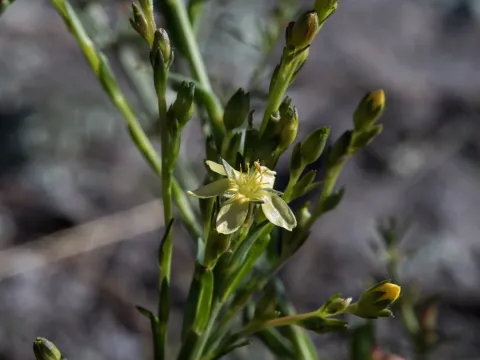
New Mexico flax
Linum neomexicanum
New Mexico flax (Linum neomexicanum) is a member of the Linaceae family, native to the high-altitude regions of the Southwestern United States. It grows best in soils that are typical of its natural arid environment.
What the section contains
New Mexico flax
Sowing should be scheduled once the soil has sufficiently warmed, as the seeds require a consistent heat source to trigger germination. Precision planting at a shallow depth is essential to ensure a high rate of seedling emergence.
The seeding rate must be balanced to provide sufficient spacing between individual plants, allowing them access to necessary nutrients and sunlight. Proper row orientation can further enhance photosynthesis efficiency.
Before sowing, the field must be cleared of perennial weeds to prevent competition during the initial growth stages. The seedbed should be firm, yet friable, to support the development of a strong root system.
Water management at the time of sowing is crucial for establishment; however, excessive irrigation should be avoided to prevent early-stage seedling damping-off. Monitoring regional precipitation patterns helps in determining the ideal sowing date.
This species thrives in well-drained, sandy-loam soils that mimic the natural conditions of its habitat. It is highly sensitive to waterlogging, which necessitates sites with excellent natural drainage.
Full sun exposure is a mandatory requirement for this plant to reach its full development potential. Partial shade may lead to stunted growth and reduced fiber or seed quality, depending on the agricultural goal.
The climate should be characterized by warm days and cooler nights, typical of semi-arid ecosystems. The plant shows significant tolerance to environmental stress once it has reached the reproductive stage.
Soil fertility management should focus on maintaining a balanced mineral level, particularly avoiding excessive nitrogen which can cause lodging. Potassium and phosphorus are beneficial for stem strength and seed maturation.
Agricultural practices include periodic inter-row cultivation to aerate the soil and control invasive vegetation. This helps in maintaining a healthy root zone environment throughout the growing season.
Root pathogens represent the most significant threat to New Mexico flax, particularly in heavy or saturated soils. Implementing a strict crop rotation cycle is the best defense against soil-borne diseases.
Pest pressure from common flax insects, such as beetles or larvae, requires proactive monitoring during the vegetative stage. Integrated pest management strategies are recommended to keep populations below economic thresholds.
Fungal diseases like rust can emerge if environmental conditions become unusually humid. Using disease-resistant varieties, if available, or providing adequate spacing to allow for airflow are effective mitigation strategies.
Weed encroachment is a primary concern for this crop, as it is relatively slow to establish compared to more aggressive weeds. Post-emergence weed control is essential for maximizing yield.
Nematode infestation can occur in fields where crop rotation has not been practiced effectively. Regular soil analysis is recommended to check for high populations of soil-dwelling pests that could jeopardize crop health.