
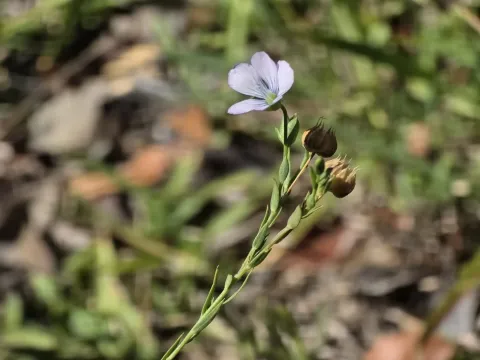
Narrowleaf flax
Linum bienne
Narrowleaf flax, known scientifically as Linum bienne, is a member of the Linaceae family, recognized for its slender stems and distinct biological cycle. Unlike the common annual flax used primarily for industrial fiber, this species exhibits traits that require careful management during the establishment phase.
What the section contains
Narrowleaf flax
The optimal sowing period occurs in early spring once soil temperatures reach a consistent range of 7 to 10 degrees Celsius. Planting during this window allows the crop to establish a robust root system before the onset of summer heat, which is essential for uniform stand development.
Precision in planting depth is critical; seeds should be placed no deeper than 1.5 to 2 centimeters. Because Linum bienne seeds are relatively small, deep burial can exhaust the plant's energy reserves, leading to poor emergence and an uneven crop stand across the field.
Seed density must be balanced to ensure proper plant spacing. While higher densities are often used for fiber production to discourage branching, they can also increase the risk of lodging and fungal infections if the ventilation between plants is insufficient.
After sowing, mechanical consolidation of the soil using a light roller is highly recommended. This practice optimizes the seed-to-soil contact, which is vital for moisture uptake and accelerating germination in variable spring weather conditions.
This crop thrives in well-drained, fertile soil, preferably with a loam or sandy-loam texture. Waterlogged soils are detrimental to Linum bienne, as its roots are highly susceptible to hypoxia, which can lead to rapid plant decay.
Light intensity plays a fundamental role in the growth and maturation of the plant. It requires full exposure to sunlight to develop long, high-quality fibers. Shaded areas should be avoided, as they lead to stunted growth and reduced fiber yield.
The plant performs best under moderate temperatures, ideally between 15 and 22 degrees Celsius. Extreme heat during the flowering phase can significantly disrupt pollination and reduce the overall seed set, negatively impacting the crop's reproductive success.
Crop rotation is an essential agricultural practice for narrowleaf flax. It should not be planted in the same field more than once every six to seven years to prevent the buildup of soil-borne pathogens and to maintain optimal nutrient levels.
Regarding fertilization, the crop shows a specific need for phosphorus and potassium to strengthen cell walls and fiber quality. Nitrogen should be applied sparingly, as an excess can lead to overly rapid growth, weak stems, and susceptibility to lodging.
The most common disease threats include Fusarium oxysporum and anthracnose. These fungal pathogens typically attack the vascular system of the flax, causing rapid wilting and necrosis, which can destroy large patches of the crop if not managed timely.
Pest pressure from the flax flea beetle is particularly high during the early seedling stage. These insects feed on young leaves and growth points, potentially causing total crop failure if the population is not controlled through timely monitoring and appropriate interventions.
The flax bollworm can significantly damage the reproductive organs of the plant. By consuming developing seeds within the capsules, this pest directly reduces the yield and economic viability of seed-production fields.
Root rots remain a persistent threat in soils with poor structural integrity or high moisture content. These conditions weaken the root system, making the plants fragile and unsuitable for industrial fiber extraction due to poor stem strength.
Integrated Pest Management (IPM) strategies, including the use of certified, treated seeds and strict adherence to planting intervals, are essential. Proactive management helps reduce the baseline infection pressure and keeps pest populations below the economic threshold.
Harvesting Linum bienne is timed precisely at the stage of early yellow ripeness. At this point, the capsules turn brown, and the stems begin to lose their green pigment, signaling that fiber maturity and seed development have reached an optimal balance.
The harvesting process typically involves pulling the plants by the roots, a method known as pulling, to maximize the length of the fibers. This process is crucial for industries that prioritize long, high-quality textile fibers.
Post-harvest, the flax is left in the field in windrows for field curing. This stage allows for the reduction of moisture content, which is necessary to prevent microbial degradation and mold growth during storage or subsequent transport.
Seed recovery requires specialized harvesting equipment designed to thresh the capsules gently. Once collected, the seeds must be dried to a moisture content of 10-12% to ensure stability and prevent rancidity or heating in storage facilities.
The final stage involves the grading of the raw material. The separated fibers are classified based on quality parameters such as length, fineness, and strength, which ultimately determine their suitability for various high-value textile applications.