
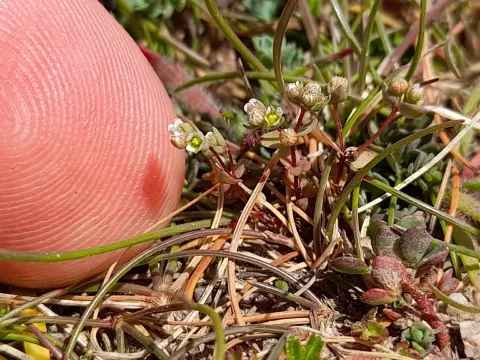
Radiola linoides
Radiola
Radiola linoides, commonly known as allseed, belongs to the Linaceae family. It is a tiny annual herbaceous plant that acts as a delicate component of moist ecosystems, often found in specific riparian habitats.
What the section contains

Radiola linoides
The life cycle begins in early spring when the soil temperature and moisture levels are optimal for germination. The seeds are extremely small and require light and high soil moisture to successfully initiate growth.
In natural conditions, the plant spreads through self-seeding. It thrives in open patches of soil where vegetation is sparse, allowing the tiny seedlings to emerge without being overshadowed by larger species.
The growth phase is very fast. The plant develops a thin, branched stem with numerous tiny flowers that mature rapidly, ensuring that the plant completes its life cycle before the onset of summer drought.
From an agricultural standpoint, it is not a commercial crop but a species of interest for habitat restoration and ecological monitoring of moist, low-nutrient soils.
Radiola linoides requires consistently moist soil to flourish. It is typically found on sandy or silty soils that retain water well but provide adequate aeration for the delicate root system.
The plant is highly sensitive to soil pH and nutrient content. It prefers slightly acidic to neutral soils and does not thrive in areas with high nitrogen input from synthetic fertilizers.
A stable, cool microclimate is essential. Radiola linoides avoids areas with extreme heat or prolonged direct sun exposure, preferring the edges of ponds, damp meadows, or forest clearings.
Good soil structure is vital, but the plant is sensitive to compaction. It cannot tolerate heavy machinery or constant foot traffic, which destroys the micro-topography necessary for seed germination.
Ecologically, the plant serves as a bio-indicator for clean, unpolluted environments, as it is highly susceptible to the chemical residues commonly found in intensively farmed areas.
The primary threat to Radiola linoides is the drainage of wetlands and changes in hydrological regimes. Even minor water table drops can lead to the local extinction of a population.
Fungal pathogens are a significant risk. During periods of stagnant air and high humidity, the plant can suffer from leaf spotting or mildew, which quickly weakens the small population.
Competition from invasive weeds is a constant pressure. Because of its tiny stature, the plant is easily outcompeted by taller grasses and robust weeds that dominate nutrient-rich agricultural soil.
Soil pollution, particularly from heavy metals or herbicide runoff, is extremely toxic to this species. Exposure to such chemicals inhibits growth and disrupts the reproductive cycle of the plant.
Climate change, manifesting as prolonged droughts, is a severe threat. Since the plant relies on moisture for survival, a few weeks of dry soil during the critical growth phase can wipe out an entire season's population.
Radiola linoides has no commercial use in modern agriculture due to its microscopic size and limited biomass. Harvesting is restricted to small-scale botanical collection for research or conservation.
The collection process requires extreme care, usually performed by hand-harvesting individual stems when the capsules are fully mature but not yet dehiscent.
Post-harvest, the plant material must be dried in a controlled environment to ensure that the moisture content is low enough to prevent rot in the seed capsules.
Seed storage should be handled in airtight, cool containers to maintain long-term viability, as the seeds are sensitive to rapid fluctuations in temperature and humidity.
In conservation projects, the aim is not to harvest but to protect the natural stands, as re-establishing a population of Radiola linoides requires specific environmental cues that are difficult to replicate artificially.