
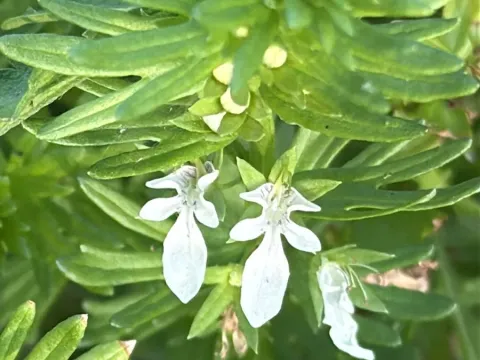
Cuban germander
Teucrium cubense
Sowing Cuban germander typically begins in early spring, once soil temperatures reach 10-12 degrees Celsius. Because the seeds require stratification, a greenhouse or nursery starter method is often preferred in cooler climates to ensure a uniform emergence of seedlings.
What the section contains
Cuban germander
Seeds should be planted at a shallow depth of 0.5-1 centimeter. Due to their small size, they are sensitive to surface soil moisture loss, necessitating gentle compaction after sowing and consistent light irrigation until the sprouts successfully break the soil surface.
When sowing in rows, maintain a spacing of 40-50 centimeters between lines. This provides adequate room for lateral root development and creates sufficient space for mechanical weeding and maintenance activities throughout the plant's growth cycle.
In regions with mild winters, dormant fall sowing is possible, allowing the seeds to benefit from early spring moisture. Growers must be cautious, however, as mid-winter thaws can trigger premature germination, leading to potential loss of the stand.
Optimal plant density depends on the final use of the crop. For biomass production, higher densities are beneficial to maximize yield per hectare, whereas seed production requires wider spacing to allow for improved airflow and sunlight penetration into the canopy.
Cuban germander (Teucrium cubense), a member of the Lamiaceae family, is a perennial herbaceous plant known for its robust adaptability. Native to the Americas, it thrives in open, sun-drenched environments with moderate soil moisture levels.
This crop has high light requirements to maintain its chemical profile. In shaded conditions, the plant tends to become leggy, and the concentration of beneficial essential oils and secondary metabolites significantly decreases, lowering the quality of the harvested biomass.
While the plant is somewhat versatile regarding soil, it performs best in well-drained, sandy or loamy soils. Waterlogged conditions are detrimental, as they encourage root rot and increase the plant's susceptibility to various soil-borne fungal pathogens.
Cuban germander exhibits moderate drought resistance due to the fine hairs on its foliage, which help reduce water loss. However, for consistent industrial-scale production, maintaining soil moisture at 60-70% of field capacity during the active growing season is essential.
The ideal soil pH for this species ranges from 6.0 to 7.5. In overly acidic soils, liming is recommended to ensure proper nutrient uptake, as stunted growth and increased disease vulnerability are often observed in low-pH environments.
The primary economic value of Cuban germander lies in its medicinal properties, specifically its content of unique terpenoids and antioxidants, which are sought after in the pharmaceutical and nutraceutical industries.
Crop yield is highly dependent on proper site management and soil fertility. Under intensive agricultural systems, growers can achieve multiple harvests per season, maximizing the return on investment for the planted acreage.
Peak concentration of active phytochemicals occurs during the full bloom stage. Harvesting at this specific phenological phase is crucial to ensuring that the dried material meets rigorous pharmacopeial standards for medicinal potency.
The plants possess strong regrowth potential, making them a suitable candidate for multi-year commercial plantations. Post-harvest care, including light fertilization and gentle inter-row cultivation, helps the plant recover quickly for the next growth cycle.
To maintain high product purity, mechanical harvesters must be carefully calibrated to avoid incorporating weeds. Using modern combine systems with high-efficiency cleaning modules helps improve output quality and reduces labor costs during post-harvest processing.
The primary threats to Cuban germander are root-borne fungal diseases, usually triggered by poor drainage or overwatering. Maintaining a strict irrigation schedule and implementing a proper crop rotation system are the best preventive measures.
Insect pests such as leaf-eating beetles and aphids can cause damage during the active growing phase. In hot, arid conditions, mite infestations can occur if field management is neglected, which can impede photosynthesis by damaging the foliage.
Weed management is vital during the early establishment phase. Mechanical hoeing or manual weeding is preferred, as the use of broad-spectrum herbicides on essential oil crops is strictly limited to prevent chemical contamination of the final medicinal product.
Weekly field scouting, especially as the plants reach the budding stage, is recommended to identify potential pest or disease hotspots early, allowing for localized interventions rather than field-wide chemical applications.
Biological control methods represent a growing trend in protecting this crop. Utilizing beneficial insects or microbial agents helps suppress pest populations naturally, ensuring that the harvested product remains free of harmful pesticide residues.
Harvesting should be conducted during dry weather to prevent spoilage. Wet, harvested biomass is highly prone to self-heating and mold development, which can rapidly destroy a harvest in storage or transport.
The harvested material must be moved to drying facilities immediately. Using active ventilation or temperature-controlled drying racks is critical to preserving the essential oil integrity and natural color of the leaves, which are key quality indicators.
The optimal drying temperature is between 35 and 40 degrees Celsius. Temperatures exceeding this threshold will lead to the evaporation of volatile compounds, significantly reducing the medicinal efficacy of the dried herb.
Once dried, the herb is processed through mechanical separators to remove woody stems and debris. High purity, characterized by a high leaf-to-stem ratio, is the primary benchmark for pricing on international botanical raw material markets.
Storage should occur in dark, cool, and well-ventilated environments. Keeping the product in moisture-proof, light-protected containers ensures long-term chemical stability until the material is processed or shipped to the end-user.