
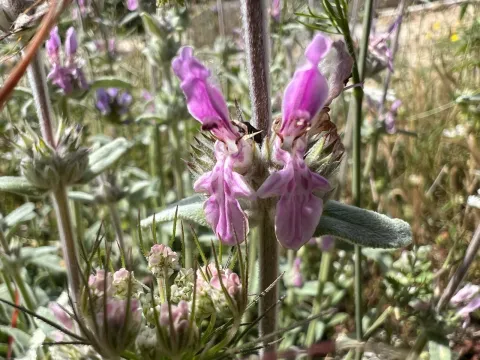
Cretan hedge nettle
Stachys cretica
Cretan hedge nettle (Stachys cretica) is a perennial herbaceous plant belonging to the Lamiaceae family. It is native to the Mediterranean region, where it naturally thrives in rocky, well-drained habitats and open grasslands.
What the section contains
Cretan hedge nettle
Botanically, the plant is distinguished by its woolly or hairy leaves, which serve as an evolutionary adaptation to reduce water transpiration in hot, arid climates. The plant produces dense, upright spikes of small, characteristic flowers during the blooming season.
For successful cultivation, the species requires excellent soil drainage. Heavy clay soils are unsuitable unless amended with significant amounts of grit or sand, as the plant is highly susceptible to root rot in damp conditions.
The climate requirements include full sun exposure, which is essential for maintaining the plant's structural integrity and preventing etiolation. While highly drought-tolerant once established, it needs consistent, albeit moderate, moisture during the initial growth stage.
In terms of agricultural and horticultural utility, Stachys cretica is highly valued for xeriscaping and rock gardens. Its ability to grow in poor, nutrient-deficient soils makes it an excellent candidate for low-maintenance landscaping and biodiversity-friendly planting.
The primary threats to the Cretan hedge nettle are soil-borne pathogens and fungi triggered by excessive soil moisture and poor air circulation. Prolonged periods of waterlogging will inevitably lead to root system decay and eventual plant collapse.
Powdery mildew is a common foliage issue, especially in high-humidity environments or where planting density is too high. Improving airflow by providing adequate spacing between individual plants is the most effective preventative measure.
Aphids and spider mites are among the most frequent pests, particularly during hot and dry spells. These pests colonize the underside of leaves and soft stems, potentially stunting growth and creating entry points for secondary infections.
Gastropods, such as slugs and snails, may target the foliage, causing ragged leaf edges. This is particularly problematic for young transplants; therefore, maintaining a clean perimeter and avoiding organic mulch directly against the crown is highly recommended.
Management strategy should focus on preventative cultural practices rather than reactive chemical treatments. Maintaining appropriate spacing, ensuring a sunny location, and strictly avoiding over-fertilization with nitrogen are key to keeping the plants healthy.