
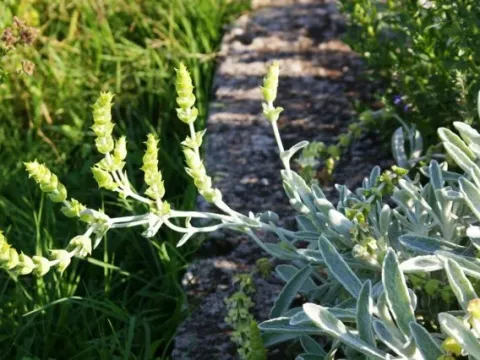
Syrian ironwort
Sideritis syriaca
Sowing Syrian ironwort is usually carried out in the spring, once the soil has warmed up to 10–12°C. In commercial fields, seeds are sown in rows spaced 40–50 cm apart to ensure good air circulation.
What the section contains
Syrian ironwort
Seedling cultivation is also a common practice to shorten the growth cycle during the first year. Seeds often require stratification to break dormancy and increase germination rates.
The sowing depth should not exceed 0.5–1 cm, as the seeds are very small and sensitive to soil density. Light rolling of the field after sowing is recommended to improve seed-to-soil contact.
The optimal plant density is about 8–10 plants per linear meter of row, which allows each bush to develop fully and produce an adequate harvest.
In regions with milder climates, late autumn sowing is an option, allowing seeds to undergo natural winter dormancy and germinate earlier in the spring.
Syrian ironwort is a perennial herb belonging to the Lamiaceae family, naturally adapted to poor, rocky, and calcareous soils typical of Mediterranean ecosystems.
The crop requires full sun exposure and performs poorly in shaded areas, where essential oil production is significantly reduced.
The plant features dense trichomes (hairs) on its stems and leaves, which serve as an adaptation to drought, minimizing water loss through transpiration.
Well-drained soil is essential for success. Water stagnation in the root zone is extremely detrimental and can cause rapid root rot and crop failure.
Ideal conditions involve warm, dry climates with minimal humidity, allowing the plant to thrive without the risk of fungal pressure associated with excess moisture.
The yield of dry biomass from Syrian ironwort ranges from 1.5 to 3 tons per hectare, depending on the plantation age and the intensity of agricultural management.
Maximum productivity is usually observed in the second and third years after planting, as the shrubs mature and reach their full flowering potential.
The raw material consists of the entire aerial part of the plant, including stems, leaves, and flowers, which are the main sources of secondary metabolites.
Market demand focuses on high-quality dried herbs for tea production and natural extracts, requiring precise timing and processing to ensure quality standards.
Maintaining a weed-free field is critical, especially during the early stages of growth, as the crop is not very competitive against fast-growing weeds.
Excessive humidity is the primary threat, as it creates favorable conditions for powdery mildew and various fungal rots that affect the hairy foliage.
Spider mites can become problematic during exceptionally hot and dry summers if the plants are stressed, though the species is generally resilient to pests.
Root rot (Fusarium spp.) is a major issue when the crop is grown in heavy, clay-rich soils that do not provide the necessary drainage for root health.
Strict crop rotation is necessary to prevent the buildup of soil-borne pathogens, with a recommended break of at least 5–6 years between plantings on the same plot.
Early removal of symptomatic plants is vital for integrated pest management to prevent the spread of infections throughout the commercial plantation.
Harvesting is conducted during the peak flowering stage, when the concentration of essential oils and flavonoids in the plant is at its highest.
Mechanical harvesting involves cutting the plants 5–10 cm above the ground, which is essential to allow the plants to regenerate and regrow in subsequent seasons.
Harvested material must be transported quickly to drying facilities to prevent heat buildup and the oxidation of volatile compounds within the plant tissues.
Drying should be performed in the shade or in specialized dryers at temperatures not exceeding 40°C to preserve the natural color and chemical properties.
Post-drying processing includes cleaning the material of mechanical impurities and grinding, followed by appropriate packaging for storage or transport.