
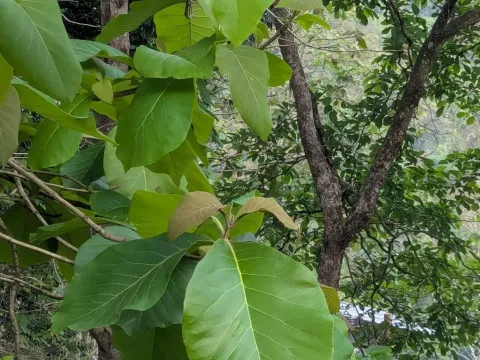
Teak
Tectona
The cultivation of teak (Tectona grandis), a member of the Lamiaceae family, begins with the careful preparation of seeds. Due to their hard, woody outer shell, teak seeds require pre-treatment, such as soaking in water for several days or mechanical scarification, to improve germination rates.
What the section contains

Teak
Seeds are typically sown in specialized forest nurseries in containers or prepared beds with light, well-draining substrate. The sowing process is usually timed to coincide with the beginning of the rainy season to utilize natural soil moisture for the initial growth phase.
Seedlings are transplanted to their permanent plantation site once they reach a height of 30 to 50 centimeters. A well-planned planting density, usually ranging from 2x2 to 3x3 meters, ensures that each tree has sufficient space to develop a strong, straight trunk.
Young plantations require intensive weeding during the first two years. Preventing competition from weeds is crucial for the survival and rapid vertical growth of the young trees during their establishment phase.
Modern forestry practices often employ vegetative propagation through stem cuttings. This technique allows for the production of clones from high-quality mother trees, ensuring genetic uniformity and better wood quality across the entire plantation.
Teak is a tropical species that thrives in warm climates with distinct wet and dry seasons. It requires consistent temperatures, ideally between 22 and 35 degrees Celsius, to maintain active physiological processes.
The plant is highly demanding regarding soil quality. It prefers deep, fertile, and well-drained alluvial soils. Waterlogged conditions must be strictly avoided, as stagnant water is lethal to teak roots and promotes fungal diseases.
As a light-demanding species, teak needs full sun exposure for optimal growth. Insufficient sunlight leads to branching and curvature of the main stem, which drastically reduces the market value of the harvested timber.
While teak can survive periodic dry spells, robust growth requires annual rainfall between 1,500 and 2,500 mm. Adequate water availability during the growing season is essential for maximizing biomass production.
Fertilization management is vital, particularly on exhausted soils. Applying essential nutrients helps maintain the rapid growth rates expected in commercial teak plantations and improves the tree's overall vigor.
The typical harvest rotation for a teak plantation spans 20 to 25 years. This long-term commitment requires professional forest management to ensure a high-quality final product at the end of the growth cycle.
Intermediate thinning operations are performed throughout the plantation's life. By removing suppressed or defective trees, foresters allocate more resources to the healthy, dominant trees, thereby increasing total timber volume.
Yield metrics depend significantly on the choice of site, the quality of the seedlings, and the intensity of silvicultural practices. A well-managed plantation can provide significant volumes of high-grade, straight-grained logs.
Teak wood is globally renowned for its exceptional properties, including natural oils that provide resistance to rot, termites, and weathering. These traits make it one of the most sought-after materials for marine and outdoor furniture.
The result of a well-executed rotation is the production of premium, knot-free timber. This high-value wood commands a significant price premium, justifying the investment and effort required for its cultivation.
The most significant biological challenge for teak is the teak defoliator (Hyblaea puera). These larvae can devastate plantations by stripping foliage, which causes massive growth stagnation if not managed timely.
Another major pest is the teak skeletonizer (Eutectona machaeralis). These insects feed on the leaf tissue, leaving only the veins behind, which severely impairs the tree’s photosynthetic capacity.
Root rot caused by various soil pathogens often occurs in poorly drained soils. Once an infection starts in a dense plantation, it can spread quickly, necessitating strict sanitary measures to contain the spread.
Fungal leaf spots can also appear in areas with high humidity and poor air circulation. Proper spacing between trees is one of the most effective preventive measures against these common foliar diseases.
Integrated Pest Management (IPM) strategies, including biological controls and monitoring, are preferred over broad-spectrum chemical sprays. This helps protect the ecosystem and ensures the safety and quality of the final wood product.
Harvesting teak involves the systematic felling of trees once they reach the target diameter. This process is a major operation that requires heavy equipment and skilled labor to ensure safety and prevent damage to remaining trees.
Immediately after felling, the logs are trimmed and debarked. Proper initial processing is essential to prevent checking and splitting, which are common issues when dealing with high-density hardwoods like teak.
Log transportation requires careful coordination due to the weight and volume of the harvest. Efficient logistics help in moving the timber to processing facilities while it is still in optimal condition.
Post-harvest, the wood must undergo a slow and controlled drying process. This stage is critical for stabilizing the wood fibers and ensuring that the timber maintains its shape and structural integrity for end-users.
Once the harvest is complete, the land is prepared for the next rotation. This involves site clearing and soil enrichment to replace nutrients removed during the previous cycle, ensuring long-term sustainability.