
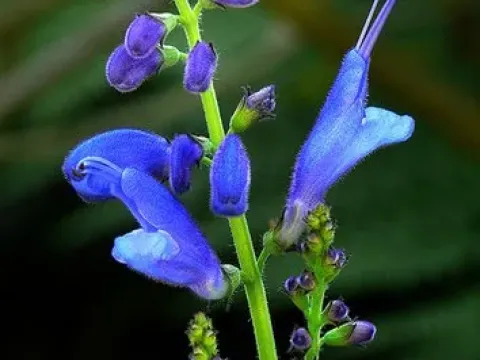
Indian Sage
Salvia indica
Sowing of Indian sage is mainly carried out in the spring when the soil warms up to 10-12 degrees Celsius. To obtain uniform germination, seeds require stratification or soaking in growth stimulants.
What the section contains
Indian Sage
In industrial production, both direct sowing in open ground and seedling methods are practiced. The use of seedlings allows for a shorter growing season in cooler climates.
The sowing depth is 1-2 centimeters, as the seeds are quite small and require firm contact with moist soil. A distance of 45-60 centimeters should be left between rows to ensure quality aeration.
The optimal sowing density is determined by the intended use: higher for green mass, lower for seed production. It is important to ensure uniform distribution of seeds across the plot.
After sowing, it is recommended to slightly compact the soil to prevent the surface layer from drying out and to promote capillary movement of moisture to the seeds.
Indian sage belongs to the Lamiaceae family and is a perennial herbaceous plant with specific requirements for insolation. The crop prefers open, sunny areas protected from strong northern winds.
The plant grows well on light, well-drained soils with a neutral or slightly alkaline reaction. Heavy clay soils with stagnant moisture are detrimental to the root system of this species.
The crop has moderate water requirements. During the active growth period, regular watering is necessary, but during the flowering phase, excessive moisture can lead to a decrease in essential oil concentration.
The temperature optimum for vegetative mass development is in the range of 20-25 degrees Celsius. The crop has medium frost resistance, so in regions with harsh winters, it requires covering or mulching.
A key factor for success is timely weeding, as sage is extremely sensitive to competition from weeds during the early stages of its development.
The yield of Indian sage varies greatly depending on the agro-background and climatic conditions of the cultivation region. On average, 1.5 to 3 tons of dry aerial mass can be obtained per hectare.
Maximum productivity is reached in the second or third year after planting, when the bushes are fully developed. In the first year, the plant's energy is mainly directed toward root system development.
The quality of the harvest is determined by the content of bioactive substances and essential oils. With intensive cultivation technology using potassium fertilization, it is possible to increase the final product yield.
Harvesting for pharmaceutical purposes is conducted in strict accordance with the plant's developmental phases. The optimal time is the onset of mass flowering, when the concentration of beneficial compounds reaches its peak.
Economic efficiency increases with the use of modern drying methods and careful processing of raw materials, which preserves the aesthetic and aromatic properties of the plant.
The most common diseases of sage are fungal infections such as downy mildew and powdery mildew. They actively develop under high humidity and in dense plantings.
Root rot poses a serious threat to young plants in the spring. Its appearance is often associated with drainage issues and waterlogging of the soil in the root zone.
Among pests, the sage moth is worth noting, as it can cause significant damage to leaves and reproductive organs. Plants are also frequently infested by spider mites in hot and dry weather.
To control insect populations, both biological insecticides and integrated protection systems are used. Prevention includes crop rotation and the removal of plant residues.
- Maintaining proper spacing between plants for ventilation.
- Regular leaf inspection for pest damage.
- Use of certified, healthy seed material.
Harvesting Indian sage is a critical technological process that requires strict adherence to timing. The main mass of leaves and inflorescences is harvested at the beginning of the flowering phase.
Cutting is performed using sharp mechanized mowers or manually, leaving 10-15 centimeters above the soil surface. This promotes rapid regeneration and the growth of new shoots.
The harvested mass must be sent for drying immediately. Using direct sunlight during drying is undesirable as it leads to pigment degradation and loss of volatile oils.
The optimal temperature for artificial drying is no more than 35-40 degrees Celsius. Exceeding this threshold results in a decrease in the quality of the finished herbal raw material.
After drying, the product is sorted to remove impurities and packaged in airtight containers that provide protection against light and moisture during storage.