
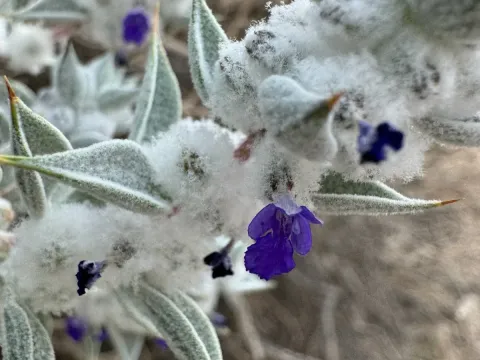
Death Valley sage
Salvia funerea
Cultivation of Salvia funerea requires mimicking the environmental conditions of the Mojave Desert where the plant naturally thrives.
What the section contains
Death Valley sage
Seeds should be sown during the cooler months to simulate natural stratification and the seasonal cycle of desert rainfall.
The substrate must be extremely well-drained, consisting primarily of sand and gravel to avoid any risk of water retention near the seeds.
Sowing depth should be shallow, as the small seeds of this species are adapted to shallow soil coverage and need adequate oxygenation.
Constant moisture is not required, as the species is adapted to survive on very limited amounts of water, needing only occasional misting during the germination phase.
Salvia funerea, known as Death Valley sage, is a member of the Lamiaceae family, native to the arid rocky slopes of desert regions.
The plant is anatomically distinguished by a dense coating of white, woolly hairs that serve as an effective thermal and moisture-retaining shield.
It thrives in full sun and requires poor, gritty, or alkaline soils that replicate its native rocky environment.
In terms of agriculture, it is classified as a low-maintenance xeriscape plant, requiring practically no fertilization or specialized chemical treatment.
The species displays remarkable endurance in high-temperature environments, showing adaptations that allow it to remain viable during prolonged droughts.
The most significant threat to the health of this species in a cultivated environment is over-irrigation, which causes rapid root and crown rot.
Due to its specialized chemistry and thick pubescence, it is largely resistant to common agricultural pests that attack more conventional sage varieties.
Fungal diseases are a primary concern, usually developing when humidity levels are kept too high or when stagnant water rests on the leaves.
Proper airflow is essential for the plant to thrive; restricted circulation in greenhouses or indoor environments often leads to premature decay.
Agricultural management should focus on dryness, keeping the foliage and root zone completely arid to prevent the growth of opportunistic pathogens.