
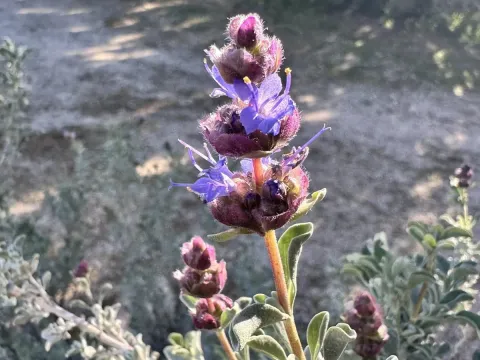
Salvia dorrii
Salvia dorrii
Salvia dorrii, commonly known as desert sage, is a species belonging to the Lamiaceae family. It is a perennial subshrub native to the arid environments of the Great Basin and deserts of the western United States.
What the section contains
Salvia dorrii
This plant is specifically adapted to survive in extreme drought conditions. It thrives in well-drained, sandy, or rocky soils with alkaline pH levels, requiring very little organic matter to maintain healthy growth.
The climatic requirements include high solar radiation and low relative humidity. It is highly suited for xeric landscapes and regions where water availability is significantly limited for other agricultural crops.
Botanically, it features silver-gray foliage covered in trichomes that serve as a defense against water loss. Its inflorescences are distinct, often showing vibrant blue or purple bracts that stand out against the desert landscape.
Regarding its utility, the plant is primarily harvested for its essential oils and is gaining popularity in landscaping for its low water demand and aesthetic value in arid-region gardens.
Root rot is the most significant threat to Salvia dorrii, usually occurring if the plant is grown in compacted, heavy soils that retain too much moisture, preventing proper aeration of the root system.
Fungal pathogens such as powdery mildew can affect the leaves if the plants are placed in areas with poor airflow and high ambient moisture, which contradicts their natural desert environment.
Pests such as aphids and spider mites may occasionally infest the plants, particularly when the sage is under environmental stress or when there is an imbalance in the surrounding ecosystem.
To mitigate these risks, irrigation should be carefully managed, ensuring that the soil dries out completely between waterings to mimic the natural hydrological cycles of its native range.
Integrated pest management should focus on mechanical removal and maintaining proper spacing between individual plants to prevent the spread of diseases and ensure optimal microclimate conditions.