
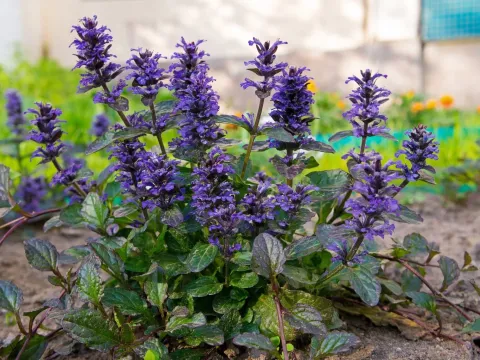
Bugleweed hybrid
Ajuga hybrids
Propagation of Ajuga hybrids is primarily performed vegetatively by dividing established clumps or by transplanting the daughter rosettes that develop on stolons.
What the section contains
Bugleweed hybrid
The optimal planting time occurs during the spring after soil thaw or in early autumn, ensuring that the root system establishes firmly before the ground freezes.
Seed propagation is also possible but requires stratification for optimal germination rates, usually done by sowing seeds in prepared trays during the winter months.
Spacing between plants should be adjusted to achieve total ground coverage within one growing season, typically spaced 20 to 30 centimeters apart depending on the variety.
Selecting vigorous and disease-free vegetative material is critical for the long-term success and uniformity of the ground cover in landscaping projects.
Bugleweed hybrid belongs to the Lamiaceae family and is widely recognized as a robust, low-maintenance herbaceous perennial capable of forming dense mats.
The crop thrives in fertile, well-draining soils with consistent moisture levels, though it exhibits significant adaptability to various soil structures including clay and loam.
Regarding light requirements, the plant shows great versatility, growing successfully in full sun if moisture is provided, or in dense shade where many other plants fail to thrive.
Climate adaptability is one of the key strengths of this crop, as it survives a broad range of temperatures and maintains its foliage coloration across diverse environments.
Agrotechnical practices include maintaining adequate soil moisture during the establishment phase and applying balanced organic fertilizers to promote rapid stolon spread.
Slugs and snails pose the most common threat to Ajuga hybrids, particularly in humid environments where they can quickly defoliate young or susceptible plantings.
Root rot and crown rot represent significant fungal threats, particularly when the soil drainage is inadequate or when plants are subjected to prolonged periods of waterlogging.
Nematodes can cause severe physiological stress to the plant, resulting in stunted growth and chlorotic leaves, which often necessitates the removal and destruction of affected patches.
Effective management focuses on site preparation to ensure proper aeration and drainage, which significantly lowers the risk of pathogens settling in the root zone.
- Regular monitoring of foliage for signs of feeding or discoloration.
- Clearing debris from around plants to reduce slug hiding spots.
- Maintaining optimal planting distances to encourage airflow.
- Applying cultural controls to manage weed competition during the first year.
- Using targeted fungicide treatments only when environmental conditions favor disease.