
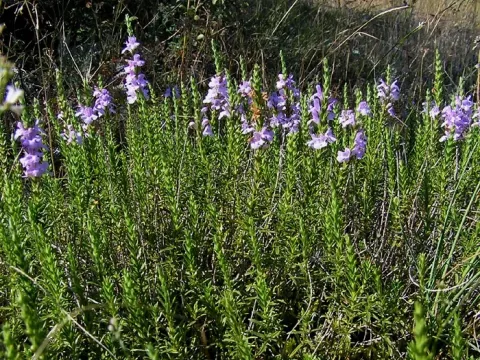
Blue savory
Satureja coerulea
Blue savory (Satureja coerulea) is a perennial aromatic plant belonging to the Lamiaceae family. In agricultural practice, seeds are sown in early spring as soon as the soil warms up to 8–10 degrees Celsius.
What the section contains
Blue savory
The seeds of the plant are very small, so when sowing in open ground, they are buried to a depth of no more than 0.5–1 cm. For uniform germination, it is preferable to use light, well-structured soils with preliminary compaction of the area.
Cultivation via seedlings in March-April is possible, which allows for significantly faster development of the crop and obtaining the first green harvest within the year of sowing. Transplanting into open ground is carried out when stable warm weather arrives.
The sowing density should ensure good ventilation between rows, as overcrowded plantings are prone to rotting in high humidity conditions. The optimal planting pattern is 45-60 cm between rows.
The plant responds well to regular soil cultivation, especially during the initial vegetation period when young growth is slowly building biomass and needs protection from weeds.
Blue savory is a light-loving crop that requires open, well-lit areas. A lack of sunlight leads to a decrease in the concentration of essential oils, making the plant less valuable for pharmacology and culinary purposes.
The crop prefers light, neutral, or slightly alkaline loamy and sandy soils. An important requirement is the absence of stagnant moisture, as the root system is sensitive to waterlogging and can easily decay.
The plant has high frost resistance and is capable of overwintering in temperate climates. It is adapted to the rocky and poor soils characteristic of its natural range in the mountain regions of the Caucasus.
During the active growth period, the crop needs moderate watering, although the need for water decreases during the flowering phase. Drought resistance allows the plant to withstand temporary periods of moisture deficit without significant damage to yields.
To maintain fertility, it is recommended to apply phosphorus-potassium fertilizers in the spring, which helps strengthen the stems and increases the winter hardiness of the perennial in subsequent seasons.
The economic productivity of Blue savory is determined by the yield of green mass and the essential oil content in the leaves and inflorescences. The highest accumulation of aromatic substances is observed during full flowering.
The yield of dry above-ground parts can vary depending on the agricultural background and the climatic conditions of the region. On average, 1.5 to 3 tons of marketable produce can be harvested per hectare when following cultivation technology.
The essential oil of Blue savory is highly valued in medicine and perfumery for its specific composition, which differs from other species of the genus Satureja. Regular pruning stimulates branching, which allows for an increase in the amount of raw material harvested.
For commercial use, the raw material is dried at a temperature no higher than 40 degrees Celsius to avoid the evaporation of volatile compounds. Properly dried herbs retain their qualities for one to two years.
The crop can be used on the same plot for up to 4–5 years, after which the productivity of the bushes begins to decline, requiring plantation renewal or rejuvenation pruning.
Typical threats to Blue savory are fungal diseases that occur when humidity levels are not managed correctly. First and foremost are root rots that affect the plant in heavy, waterlogged soils.
In conditions of high air humidity, plantings may suffer from powdery mildew. Prevention involves thinning out the bushes and ensuring free air access to the root zone.
Among pests, aphids and spider mites pose the greatest danger, feeding on the juices of young shoots. Biological agents are used to combat them, as chemical products may reduce the quality of the essential oil.
Slugs and snails can damage young seedlings in the spring. Using gravel or other dry materials for mulching around the base of the bush effectively limits pest access to the tender stems.
Adhering to crop rotation is a mandatory condition for protection against soil pathogens. It is not recommended to plant savory after other members of the Lamiaceae family to avoid the accumulation of specific pests.
Harvesting is carried out during the mass flowering phase when the concentration of biologically active components reaches its maximum. At this time, the plant possesses the most pronounced aroma and medicinal properties.
The green mass is cut at a height of 10-15 cm from the soil level. It is important to use a sharp tool to avoid damaging the root collar, which is critical for the survival of the perennial during winter.
For industrial purposes, harvesting is carried out mechanically using special combines. During manual harvesting, the cut stems are tied into bundles and hung in dry, shaded places.
A second harvest can be obtained in late summer or early autumn if the plant has been timely fertilized and provided with moisture after the first cut. However, to maintain the vitality of the bush before winter, cutting should not be done later than August.
After harvesting, the raw material undergoes initial cleaning from impurities and subsequent final drying, after which it is ready for processing into extracts or for sale as dried spice.