
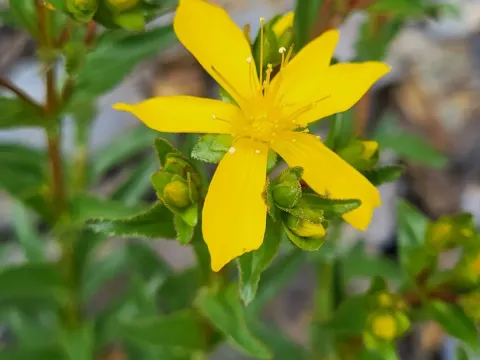
Eastern St. John's-wort
Hypericum orientale
Sowing Eastern St. John's-wort is best performed in late autumn, as the seeds of this perennial plant require stratification to ensure uniform germination during the following spring.
What the section contains
Eastern St. John's-wort
For spring sowing, seeds should be planted in March or April in prepared seed trays or open ground, provided that the climate is stable and frost-free for tender seedlings.
Seeds are extremely small and need exposure to light to germinate, so they should only be lightly pressed into the soil or covered with a very thin layer of fine substrate.
Once seedlings reach the two-to-three leaf stage, thinning is necessary to ensure each plant has adequate space, which prevents overcrowding and improves overall plant health.
For commercial production, a planting row spacing of 45 to 60 centimeters is recommended to allow for efficient mechanized field maintenance and weeding operations.
Eastern St. John's-wort, belonging to the Hypericaceae family, is a sun-loving plant that requires open, well-lit locations to thrive and produce its full range of active compounds.
The plant is relatively adaptable regarding soil types but performs best in loose, well-drained sandy loam or loam soils with a neutral to slightly acidic pH level.
While the species exhibits moderate drought tolerance, regular irrigation is essential during critical growth phases, particularly throughout the budding and flowering stages.
This plant originates from rocky slopes, meaning it is highly sensitive to waterlogged soils; excellent drainage is non-negotiable for successful long-term cultivation.
The species is hardy and capable of surviving cold winters, although in regions with severe frosts and no snow cover, applying organic mulch around the base provides vital protection.
Yields of raw biomass typically increase as the plantation matures, with the highest productivity levels observed in the second and third years following initial establishment.
Implementing optimized agrotechnical practices, including the application of phosphorus-potassium fertilizers, significantly enhances both the biomass and the concentration of active ingredients.
The expected dry matter yield is generally between 20 and 25 percent of the fresh weight, a factor that must be considered when calculating processing and storage capacity.
Systematic harvesting of the above-ground biomass encourages lateral branching and bushy growth, often allowing for two harvests per season in regions with a long growing period.
Economic utility of this crop encompasses the pharmaceutical industry, health supplements, herbal tea production, and the extraction of compounds with antiseptic properties.
The most significant threats to the crop include fungal pathogens like powdery mildew and fusarium wilt, which often proliferate under conditions of high humidity and poor air circulation.
Pests, particularly aphids and various leaf-eating insects, can damage the foliage and floral stalks, which negatively impacts the market quality of the harvested medicinal raw material.
To mitigate these risks, farmers should maintain strict crop rotation schedules, avoid dense planting patterns, and ensure that the rows remain free from aggressive weeds.
In the event of heavy pest pressure, biological control agents or soft-chemical interventions should be prioritized to maintain the pharmaceutical safety standards of the harvest.
- Regular field monitoring
- Proper weed control
- Prevention of soil moisture excess
Harvesting should be conducted at the peak of full flowering when the concentration of essential oils and flavonoids within the plant tissues is at its maximum physiological level.
The harvest involves cutting the upper 20 to 30 centimeters of the stem, carefully avoiding the tougher, woody lower parts that lack sufficient medicinal potency and market value.
It is vital to harvest during dry, sunny conditions, as moisture on the harvested material can lead to rapid decay and the development of mold during the transport and drying phases.
The harvested material must be moved to the drying facility immediately, as prolonged storage in piles causes self-heating, which results in significant loss of color and quality.
Drying should be managed in shaded, well-ventilated areas or controlled industrial dryers at temperatures not exceeding 45 degrees Celsius to preserve the plant's delicate bio-compounds.