
Thick-leaved fan-flower
Scaevola crassifolia Labill.
Description
Growing requirements
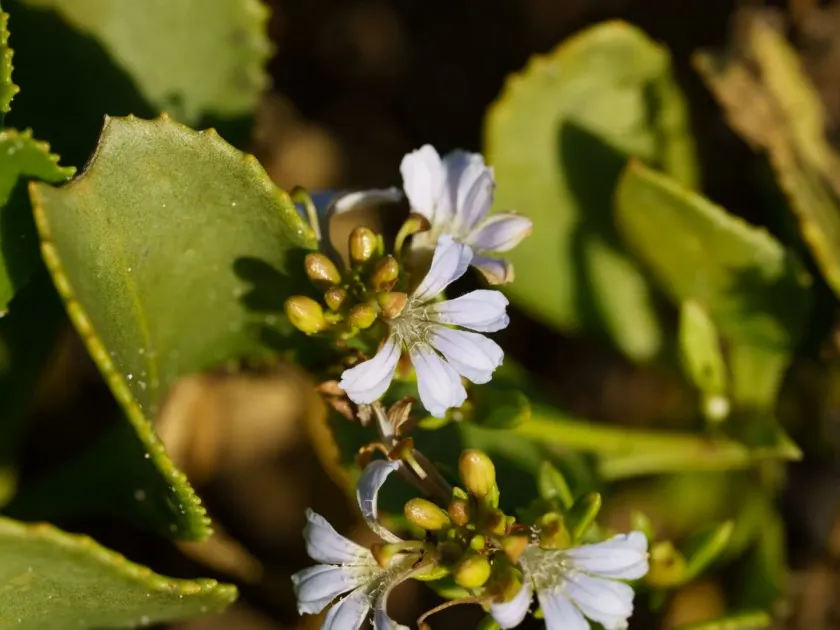
Thick-leaved fan-flower (Scaevola crassifolia) is a perennial shrub belonging to the Goodeniaceae family. Native to the coastal regions of Western and Southern Australia, this plant is well-known for its exceptional ability to colonize sand dunes and saline environments.
The plant is distinguished by its fleshy, leathery leaves which act as water storage organs, classifying it as a succulent sub-shrub. Its growth habit can be prostrate or semi-erect, forming dense mats that help stabilize loose sandy soils against erosion from wind and water.
Cultivation requirements prioritize full sun exposure and well-drained, sandy soils. Scaevola crassifolia is highly tolerant of maritime winds and salt spray, making it an ideal candidate for coastal landscaping projects where few other plants can thrive.
The plant has minimal water requirements once established, displaying impressive drought resistance. While it thrives in warm, temperate climates, it requires protection from waterlogged soil, as its root system is highly susceptible to decay in stagnant water conditions.
Horticulturally, it is valued for its long-lasting, fan-shaped flowers which range from pale blue to lilac. Beyond its aesthetic appeal, it serves as a functional plant for slope stabilization, xeriscaping, and creating low-maintenance landscape covers in arid environments.
Main diseases and pests
The primary threats to Scaevola crassifolia are soil-borne fungal pathogens, such as Phytophthora or Pythium species, which thrive in poorly drained or overly damp conditions. These lead to root rot and eventual plant collapse if not addressed early.
Pests including mealybugs and spider mites may occasionally infest the plant, particularly in sheltered or poorly ventilated areas. These insects thrive on the succulent foliage, leading to yellowing, distortion, and loss of overall plant vigor.
Preventative management is essential and includes ensuring sufficient spacing between plants to promote airflow. Proper drainage installation is the single most effective way to protect the plant from the most common environmental-induced diseases.
Integrated pest management, involving manual removal of infested shoots and the use of appropriate contact insecticides, is recommended if pest populations exceed economic or aesthetic thresholds. Avoiding overhead irrigation is crucial to prevent fungal spore dispersal.
With correct site selection and careful monitoring of irrigation levels, the thick-leaved fan-flower remains a hardy and disease-resistant plant. Most issues encountered are usually the result of over-maintenance rather than lack of care.