
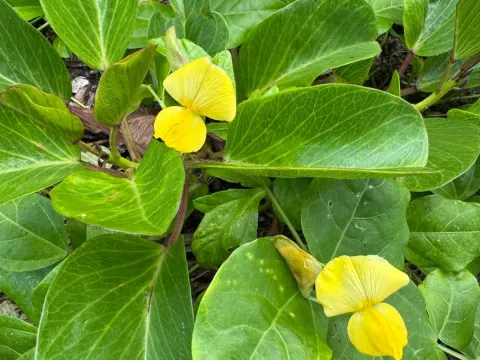
Vigna
Vigna Savi
Vigna is a thermophilic crop, meaning planting time is strictly determined by soil temperature. Seeds should only be sown when the soil temperature at a depth of 10 cm reaches at least +15°C to +18°C.
What the section contains
 Adzuki bean
Vigna angularis (Willd.) Ohwi & H. Ohashi
Adzuki bean
Vigna angularis (Willd.) Ohwi & H. Ohashi
 Bambara groundnut
Vigna subterranea (L.) Verdc.
Bambara groundnut
Vigna subterranea (L.) Verdc.
 Cowpea
Vigna unguiculata (L.) Walp. subsp. cylindrica (L.) Verdc.
Cowpea
Vigna unguiculata (L.) Walp. subsp. cylindrica (L.) Verdc.
 Moth bean
Vigna aconitifolia (Jacq.) Maréchal
Moth bean
Vigna aconitifolia (Jacq.) Maréchal
 Mung bean
Vigna radiata (L.) R. Wilczek
Mung bean
Vigna radiata (L.) R. Wilczek var. radiata
Mung bean
Vigna radiata (L.) R. Wilczek
Mung bean
Vigna radiata (L.) R. Wilczek var. radiata
 Rice bean
Vigna umbellata (Thunb.) Ohwi & H. Ohashi
Rice bean
Vigna umbellata (Thunb.) Ohwi & H. Ohashi
 Sea bean
Vigna marina (Burm.) Merr.
Sea bean
Vigna marina (Burm.) Merr.
 Snail vine
Cochliasanthus caracalla (L.) Trew ex A. Delgado et al.
Vigna
Vigna unguiculata (L.) Walp.
Snail vine
Cochliasanthus caracalla (L.) Trew ex A. Delgado et al.
Vigna
Vigna unguiculata (L.) Walp.
 Vigna luteola
 (Jacq.) Benth.
Vigna luteola
Vigna luteola (Jacq.) Benth.
 Vigna mungo
 (L.) Hepper
Vigna mungo
Vigna mungo (L.) Hepper
 Vigna trilobata
 (L.) Verdc.
Yardlong bean
Vigna unguiculata (L.) Walp. subsp. sesquipedalis (L.) Verdc.
Yardlong bean
Vigna unguiculata (L.) Walp. subsp. unguiculata
Vigna trilobata
Vigna trilobata (L.) Verdc.
Yardlong bean
Vigna unguiculata (L.) Walp. subsp. sesquipedalis (L.) Verdc.
Yardlong bean
Vigna unguiculata (L.) Walp. subsp. unguiculata
Vigna
In most temperate regions, the sowing period typically falls in late May or early June, once all danger of frost has passed. For earlier yields, professional growers often utilize transplanting methods.
Seedlings are typically transplanted at 25–30 days old into prepared beds. Proper spacing is essential to ensure adequate airflow and sunlight penetration, which significantly reduces the risk of fungal diseases.
Seeds are sown at a depth of 3–5 cm. Under optimal heat and moisture conditions, germination occurs within 7 to 10 days, allowing the plants to establish a robust root system quickly.
It is crucial to avoid sowing into cold or waterlogged soil, as this significantly increases the risk of seed decay and uneven crop emergence, which can impact final yields.
Belonging to the Fabaceae family, Vigna is highly valued for its drought tolerance and heat resistance. It thrives in sunny, sheltered locations where temperatures consistently remain above +25°C.
The crop is adaptable to various soil types but performs best in well-drained sandy loams or loams with a neutral to slightly acidic pH. Avoiding heavy clay soils prone to waterlogging is vital.
While known for its hardiness, Vigna requires consistent moisture during the critical flowering and pod-setting stages. A lack of water during this period can lead to flower abortion.
Agricultural management includes trellising for indeterminate or vining varieties. Vertical support is recommended to improve air circulation, prevent pod contact with the soil, and simplify harvest.
Nutrient management is straightforward; however, excessive nitrogen fertilization should be avoided as it stimulates excessive foliage growth at the expense of pod production.
Yield potential depends heavily on variety and local climate conditions. Generally, well-managed crops can produce between 1.5 and 3 kg of fresh pods per square meter.
A key biological advantage of Vigna is its indeterminate growth habit, which allows for a prolonged harvest period continuing until the first autumn frosts, assuming weather remains warm.
Productivity is optimized by regular, selective harvesting. Removing pods as they reach technical maturity encourages the plant to channel energy into forming new blossoms and pods.
Phosphorus and potassium applications during the budding stage are beneficial for maximizing pod quality and grain development, ensuring that the crop reaches its full potential.
Efficient farm management, including weed control and irrigation monitoring, is necessary to sustain high yields throughout the growing season and minimize competitive stress on the plants.
Common diseases affecting Vigna include powdery mildew and various bacterial blights, which are more prevalent in high-humidity conditions or dense, poorly ventilated planting sites.
Pest pressures primarily include aphids, spider mites, and bean flies. Aphids, in particular, can rapidly multiply on tender shoots, potentially transmitting viral diseases to the crop.
Integrated Pest Management (IPM) strategies are highly recommended. These include crop rotation cycles of at least three to four years to prevent the buildup of soil-borne pathogens.
Regular monitoring for early signs of pests or disease is essential. Using biological controls or targeted, eco-friendly interventions can help maintain a healthy crop without compromising product safety.
Maintaining a clean field environment by removing crop residues and weeds helps disrupt the lifecycle of many common pests and prevents them from overwintering near the production site.
For vegetable consumption, Vigna pods are harvested at the stage of technical maturity—while they are still tender, juicy, and before the seeds inside become overly developed or fibrous.
Harvesting should be done every 3 to 5 days to ensure maximum quality. Leaving pods on the plant too long results in tough, stringy textures that are less desirable in the fresh market.
When grown for grain, harvesting begins when the pods have fully dried on the plant, turning brown or mottled, and the seeds have become hard and moisture content has dropped.
Harvested pods intended for fresh use should be cooled immediately and stored at low temperatures to retain freshness and crispness for several days following the harvest.
As a legume, Vigna roots leave behind nitrogen-rich residues in the soil. Once the harvest is complete, the remaining biomass can be incorporated into the soil to improve overall fertility for future crops.