
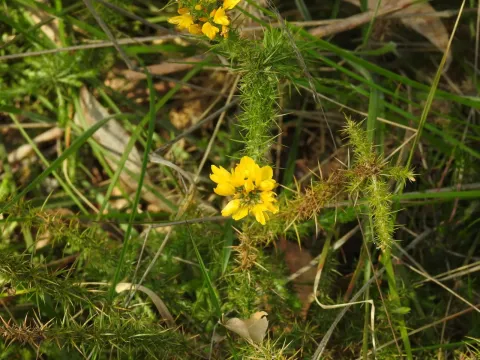
Dwarf gorse
Ulex minor
Dwarf gorse (Ulex minor) is a low-growing, evergreen thorny shrub belonging to the Fabaceae family. It is distinct from the common gorse due to its smaller stature, typically reaching heights of up to one meter, and its dense, intricate branching pattern.
What the section contains
Dwarf gorse
The native distribution of this species spans the Atlantic regions of Western Europe. It is well-adapted to maritime climates, characterized by mild, frost-free winters and high atmospheric humidity. It requires a specific ecological niche to thrive, avoiding extreme continental conditions.
From an agricultural standpoint, the plant is valued for its ability to occupy acidic, nutrient-poor, and sandy soils where traditional crops often fail. Its deep root system allows it to access minerals and moisture that are unreachable for shallower-rooted plants.
Dwarf gorse is a heliophilic plant, meaning it requires full exposure to sunlight to maintain its structural integrity and reproductive health. In shaded environments, the plant exhibits reduced vigor and poor development, which significantly limits its potential biomass production.
The plant exhibits a unique symbiotic relationship with Rhizobium bacteria, allowing it to fix atmospheric nitrogen. This ecological service improves soil structure and nutrient content over time, making it a valuable tool in long-term agroforestry and soil improvement projects.
Pathogenic fungi of the genera Fusarium and Phytophthora pose the greatest threat to dwarf gorse plantations. These infections are typically triggered by poorly drained soils, which lead to waterlogging and subsequent root damage.
Various insect pests, such as the gorse weevil (Exapion ulicis), target the seeds and flowers, potentially hindering natural regeneration. Monitoring pest populations during the flowering period is essential for maintaining plant health.
Abiotic stress, including extreme winter freezes and drying winds, can cause significant dieback of the terminal shoots. Protective measures, such as windbreaks or winter mulching, are recommended in areas prone to sudden climatic shifts.
Invasive weed encroachment represents a significant challenge during the initial establishment phase. Young gorse plants grow slowly and are easily suppressed by faster-growing grasses, necessitating weed control until the shrub canopy closes.
Incorrect soil chemistry, particularly excessive alkalinity, leads to chlorosis. The plant is highly specialized for acidic environments, and any deviation in soil pH can disrupt its internal metabolism and reduce its overall resistance to environmental pressures.