
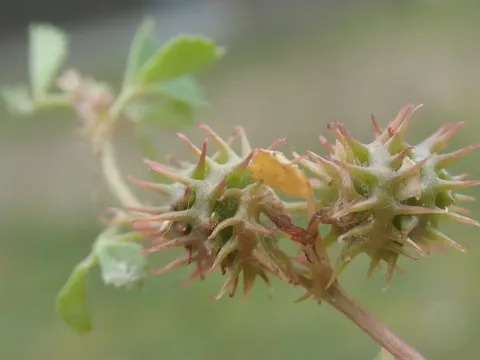
Early medic
Medicago praecox
Early medic (Medicago praecox) belongs to the legume family (Fabaceae). This perennial herbaceous plant is valued for its ability to develop rapidly during the early spring period, which is the defining characteristic of this specific species.
What the section contains
Early medic
Sowing dates depend on the climatic zone, but the optimal period is early spring, as soon as the soil warms up to 5–8 degrees Celsius. The plant has high germination energy, allowing it to successfully compete with weeds at the beginning of the vegetative stage.
When sowing, it is important to consider the seeding depth, which typically ranges from 1 to 2 cm depending on soil type and moisture. On lighter soils, slightly deeper planting is acceptable to ensure seed contact with the moist substrate.
The crop requires weed-free fields as seedlings can be sensitive to strong competition in the initial stages. A row-seeding method with 15 cm spacing is recommended to ensure a uniform stand.
Inoculation of seeds with specific strains of nodule bacteria before sowing significantly increases yield and green mass quality, as medic actively forms a symbiosis with nitrogen-fixing microorganisms.
This species prefers well-drained, neutral, or slightly alkaline soils. A high lime content in the soil has a positive effect on the development of the root system and overall plant productivity.
Early medic shows resilience to drought conditions due to its deep taproot system, which is capable of reaching deep soil horizons to extract moisture.
Optimal climatic conditions for the crop include ample sunlight and moderate temperatures. It is sensitive to severe waterlogging and standing water, which can lead to root rot.
The plant is well-adapted to the Mediterranean region but is successfully cultivated in areas with similar temperature regimes where early emergence from dormancy is critical.
To maintain soil fertility in crop rotations, early medic is often used as a phytomeliorative crop, capable of significantly improving soil structure and enriching it with biological nitrogen.
The green mass yield of early medic is determined by usage intensity and agricultural practices. Due to its fast growth rate during the spring regrowth phase, it allows for the first full cutting earlier than other medic varieties.
Maximum productivity is observed in the second and third year of the stand. With intensive irrigation and mineral fertilization, dry matter yields can reach high levels comparable to industrial alfalfa varieties.
The quality of the hay is considered high due to an optimal leaf-to-stem ratio during early development stages. The green mass contains a significant percentage of crude protein and carotene.
The regrowth capacity of the crop is moderate; however, under favorable moisture conditions, it can form 2–3 full cuttings per season, providing quality hay or haylage for livestock.
Using it as a pasture crop requires caution due to the risk of bloat in ruminants, so grazing in mixtures with grasses is recommended.
Typical pests for Medicago praecox include the alfalfa plant bug, weevils, and various aphid species, which can damage reproductive organs and reduce the photosynthetic rate of the plants.
Among fungal diseases, Ascochyta leaf spot is the most common, manifesting as spots on the leaves. Powdery mildew may also occur under conditions of high humidity and poor air circulation within the stand.
Root rots may arise if agricultural practices are neglected, especially in heavy, waterlogged soils. Prevention includes crop rotation and the use of disease-resistant seeds.
To control pest populations, integrated methods are used, including biological control and targeted insecticide application during periods of peak parasite activity.
Adhering to mowing schedules helps significantly reduce the infection pressure, as removing the above-ground biomass prevents the accumulation of pathogens in dying plant parts.
The primary time to begin harvesting is the early flowering phase. It is at this moment that maximum nutrient accumulation in the aerial part of the plant occurs while maintaining high nutritional value.
To obtain hay with high protein content, it is crucial to carry out mowing as promptly as possible, as delays lead to stem lignification and the loss of leaves, which hold the bulk of the carotene.
The hay-drying process should occur rapidly, preferably in windrows with subsequent turning. This preserves the green color of the mass and prevents degradation from UV light exposure.
When using for silage, wilting the mass to 50–60% moisture is recommended. This prevents the formation of butyric acid and ensures the production of quality, aromatic fodder for livestock.
Harvesting for seeds requires monitoring the maturity of the pods. It is important to complete the work before mass pod shattering to minimize yield losses during threshing.