
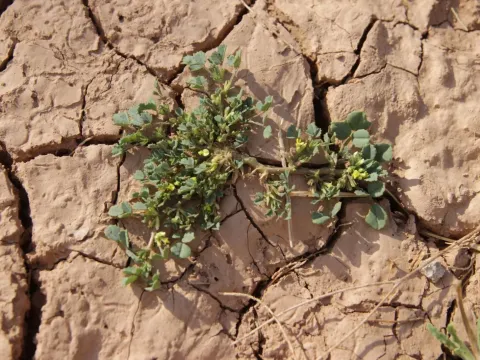
Snake fenugreek
Trigonella anguina
Snake fenugreek (Trigonella anguina) is an annual leguminous plant primarily grown as a forage or green manure crop. Sowing is typically conducted in early spring as soon as the soil reaches temperatures of 8–10 degrees Celsius, ensuring high germination energy.
What the section contains
Snake fenugreek
To achieve uniform emergence, precise seedbed preparation, including cultivation and rolling, is essential. Sowing depth should be kept between 2–3 centimeters to ensure seeds reach the surface while maintaining adequate moisture contact.
Seeding rates depend on the intended use: for green biomass, a row spacing of 15–20 centimeters is recommended. For seed production, wider rows are preferred to improve air circulation and reduce the risk of fungal diseases.
The plant exhibits rapid initial growth, which allows it to compete effectively with weeds during the early vegetative stages. However, keeping fields clean during the first month of development is crucial for establishing an optimal plant density.
Sowing timing varies by region, but in areas with hot summers, early planting is vital. This ensures that the main vegetative phase occurs during periods of moderate temperatures and sufficient soil moisture reserves.
Trigonella anguina prefers open, well-lit areas because it is a highly photophilic crop. Insufficient light leads to stem elongation and a significant decrease in biomass productivity, making site selection a critical factor for success.
Soil requirements are moderate; the plant thrives best in fertile loamy or sandy loam soils with a neutral to slightly alkaline pH. Excessively acidic or saline soils inhibit root system development and slow overall plant growth.
While the plant has moderate drought tolerance, it requires consistent moisture during the budding stage to maximize biomass yield. Conversely, waterlogging is detrimental, as it encourages root rot and impairs nitrogen fixation.
Optimal growth occurs at temperatures between 18–25 degrees Celsius. The crop can survive short-term light spring frosts, but prolonged exposure to extreme temperature fluctuations can induce stress and limit potential yield.
Effective soil aeration is a key agronomic requirement. Regularly cultivating inter-row spaces helps manage weeds and improves oxygen exchange in the rhizosphere, which stimulates the activity of nitrogen-fixing bacteria attached to the roots.
The yield of snake fenugreek depends largely on the intensity of management and soil fertility. Under optimal conditions, green biomass yields can reach 15–25 tons per hectare, provided the plant stand is sufficiently dense.
For seed production, yields typically range from 0.8 to 1.5 tons per hectare. Productivity can be significantly enhanced by applying phosphorus and potassium fertilizers, which support flowering and bean formation.
Micronutrient supplementation, particularly with molybdenum, is essential for optimal nitrogen fixation. This natural nitrogen accumulation improves soil fertility for subsequent crops in the rotation cycle.
As a legume, the plant serves as an excellent predecessor in crop rotations. Its robust root system improves soil structure, leaving behind significant organic matter that benefits future grain or vegetable plantings.
Economic output is heavily influenced by the timing of the harvest. Early harvesting prioritizes biomass quality and protein content, whereas late harvesting is focused on maximizing the yield of mature, viable seeds.
Like most legumes, snake fenugreek is susceptible to powdery mildew, especially under conditions of high humidity and poor air circulation. Proper spacing and avoiding excessive planting density are the primary preventive measures.
Root rots pose a serious threat, usually developing when drainage is poor or fields are over-irrigated. Infected plants show symptoms of wilting and often die early, causing gaps in the field that reduce overall crop productivity.
Pea leaf weevils are among the most destructive pests, damaging young seedlings and reducing the nitrogen-fixation capability of the crop. In cases of severe infestation, targeted insecticide applications are required to protect the stand.
Aphids can colonize the inflorescences, sucking sap and suppressing the development of pods. This damage lowers seed quality and yield, making pest management during the flowering period a necessity for high-quality production.
A structured crop rotation is vital for long-term health. It is not recommended to return fenugreek to the same field more than once every 3–4 years, as this cycle effectively disrupts the life patterns of species-specific pathogens.
Harvesting for green biomass is best performed during the flowering phase, as this is when the plant contains the highest concentration of protein and biologically active compounds. Efficient mowing equipment is needed for timely processing.
For seed production, growers must wait for the pods to turn yellow. Harvesting prematurely results in low-viability seeds with poor shelf life. Operations should be scheduled during dry weather to maintain high post-harvest quality.
Post-harvest handling involves cleaning the seeds and drying them to a moisture content of 12–14%. This step is essential to ensure long-term storage stability and to prevent the development of mold during warehouse storage.
Straw remnants after threshing can be utilized as secondary feed or incorporated into the soil as organic matter. This practice supports the ongoing recovery of soil fertility and enhances the yield of subsequent crops.
Timely harvest management is crucial because pods may shatter if left in the field for too long. Operational efficiency is the primary factor determining the economic viability of snake fenugreek cultivation.