
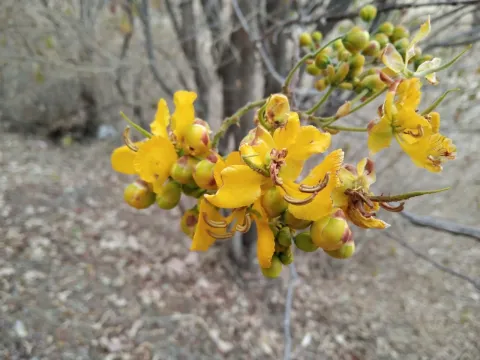
Senna singueana
Senna singueana
Senna singueana belongs to the Fabaceae family and is a deciduous tree or shrub native to tropical Africa, ranging from Sudan down to South Africa. It is widely recognized for its ecological resilience, thriving in savannahs and open woodlands. This species is gaining attention in sustainable agriculture for its drought-tolerant properties and adaptability.
What the section contains
Senna singueana
The plant thrives in regions with warm climates and clear seasonal precipitation patterns. It requires well-drained, sandy or loamy soils to prevent root decay. Its biological structure, characterized by a deep taproot, allows it to survive in arid environments, making it a valuable candidate for reforestation and soil protection projects.
Botanically, Senna singueana is distinguished by its pinnate leaves and vibrant yellow raceme flowers. These flowers are highly attractive to bees and other pollinators, contributing to biodiversity within farm landscapes. The tree typically reaches heights between 3 and 10 meters, providing significant canopy cover.
Cultivation practices involve seed propagation, often requiring scarification to break dormancy and ensure uniform germination. Once established, the plant is relatively low-maintenance. Regular pruning and minimal organic fertilization are recommended during the early development stages to stimulate growth and optimize foliage production.
The economic value of Senna singueana is diverse, ranging from its use in traditional pharmacopeia for its laxative properties to its role as fodder for livestock. Furthermore, as a nitrogen-fixing legume, it plays a vital role in soil fertility management, improving nitrogen content for intercropped species in agroforestry systems.
The primary threats to Senna singueana include fungal root rot, which typically occurs in waterlogged soil conditions. Additionally, the plant is susceptible to attacks by various aphids and weevils that feed on the soft tissue of the leaves and the developing seeds within the characteristic legume pods.