
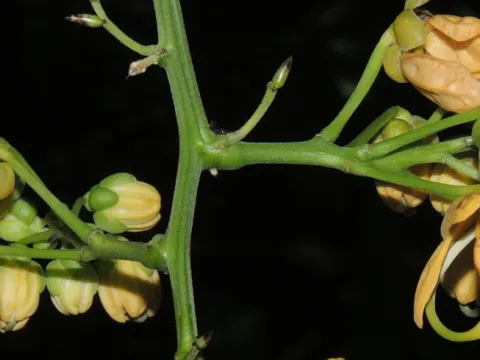
Senna quinqueangulata
Senna quinqueangulata
Senna quinqueangulata is a woody shrub belonging to the Fabaceae family, naturally occurring in the tropical rainforest regions of Central and South America.
What the section contains
Senna quinqueangulata
The crop thrives in well-drained, nutrient-rich soils with a slightly acidic to neutral pH profile, requiring adequate aeration to support its extensive root system.
Regarding climatic conditions, the plant is heat-loving and requires consistent temperatures between 22 and 28 degrees Celsius, being highly intolerant to freezing or cold drafts.
Bright, filtered sunlight is essential for the healthy development of this species, as low-light conditions often inhibit flowering and weaken the structural integrity of the stems.
Agricultural management requires consistent moisture levels during the growing season while ensuring that water does not pool, as stagnant moisture is detrimental to the plant's health.
Common pests affecting Senna quinqueangulata include spider mites, aphids, and whiteflies, which thrive in environments where ambient humidity is not properly managed.
Fungal diseases, specifically root rot and powdery mildew, are the primary threats that occur when the planting site lacks proper ventilation or is subjected to overwatering.
Management of these threats involves careful observation and the application of integrated pest management strategies, focusing on biological controls whenever possible.
Maintaining optimal spacing between individual plants is critical to prevent the rapid spread of pathogens and to ensure that all plants receive uniform airflow.
Early intervention, such as removing affected foliage or applying targeted treatments, is key to preventing widespread damage and maintaining the overall vitality of the plantation.