
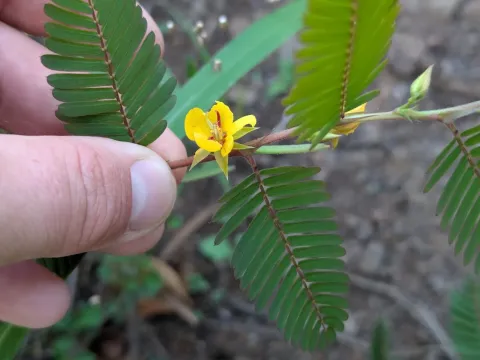
Sensitive partridge pea
Chamaecrista nictitans
Chamaecrista nictitans is a warm-season annual legume that requires stable warm temperatures to germinate. Sowing should only begin after the danger of frost has passed and soil temperatures consistently exceed 18 degrees Celsius.
What the section contains
Sensitive partridge pea
Seeds should be planted at a shallow depth of 1 to 2 centimeters to ensure they emerge effectively without exhausting their stored energy. Using a precision seed drill helps maintain uniform spacing between plants.
Optimal row spacing depends on the primary use of the crop. For forage production, narrower rows are preferred to maximize ground cover, while wider spacing may be used for seed multiplication plots.
Firming the soil with a roller immediately after sowing is recommended to improve seed-to-soil contact. This practice is essential for moisture retention, which promotes rapid and uniform seedling emergence.
In regions with a short growing season, early planting is vital to maximize the vegetative period. Utilizing high-quality, pre-tested seeds ensures better establishment even under slightly challenging environmental conditions.
The sensitive partridge pea thrives in well-drained soils ranging from sandy loams to clay loams. It possesses a high tolerance for low-fertility soils due to its ability to fix atmospheric nitrogen through symbiotic bacteria.
Regarding moisture, the plant is relatively drought-tolerant once established but requires consistent rainfall or irrigation during the early growth stages to reach its full biomass potential.
The crop is highly light-demanding and performs poorly in shaded areas. Selecting open, sunny locations is crucial for achieving high photosynthetic activity and robust plant development.
Soil pH should ideally be neutral to slightly acidic. While the plant can tolerate a range of conditions, extremely alkaline soils can impede nutrient uptake and restrict the activity of nitrogen-fixing nodules.
Temperature management is critical, as the plant prefers warm conditions between 22 and 30 degrees Celsius. Development slows significantly if temperatures drop, and the plant is highly sensitive to frost.
The biomass yield of Chamaecrista nictitans is influenced by soil nutrient availability and effective management. When managed as a forage crop, it provides a high-protein feed source for livestock.
Harvesting at the peak of the flowering phase is recommended to capture the highest nutritional value. At this stage, the plant offers the best balance of protein content and digestible fiber.
Seed production is prolific, and yields can be substantial under favorable conditions. Harvesting should be performed when the pods turn dark to minimize pre-harvest shattering and losses.
As a green manure or cover crop, the plant contributes significantly to soil organic matter. Its extensive root system helps improve soil structure and water infiltration rates over time.
Integration into crop rotations enhances the nitrogen status of the soil for subsequent crops, reducing the need for synthetic nitrogen fertilizers in the overall farm system.
Root rot diseases pose the most significant threat, especially in areas with poor drainage or during extended periods of waterlogging. Proper site selection and land leveling are key preventative measures.
Foliar diseases, such as leaf spots, can occur under high humidity conditions. Ensuring adequate airflow between plants by controlling planting density helps mitigate these fungal issues.
Insect pests, including weevils, can affect both the roots and seeds. Regular field monitoring is necessary to determine if economic thresholds are reached that warrant intervention.
Weed competition during the initial growth phase can severely limit crop success. Mechanical cultivation between rows is an effective way to manage weeds without relying on herbicides.
The overall susceptibility to threats is relatively low if the plant is grown in its preferred environment, emphasizing the importance of matching the site conditions to the plant's needs.