
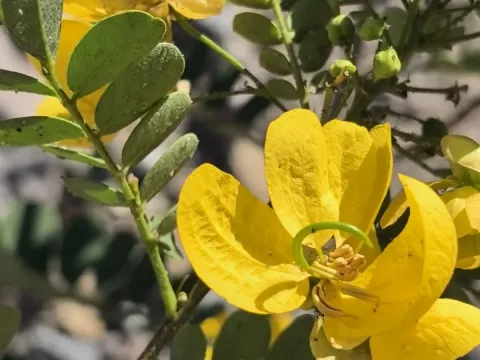
Senna pallida
Senna pallida
Senna pallida seeds have a hard seed coat, which necessitates pre-sowing treatment to ensure a uniform and high germination rate.
What the section contains
Senna pallida
Scarification or soaking the seeds in warm water for at least 24 hours is highly recommended before planting them into the substrate.
Sowing should be performed when the soil temperature consistently stays above 15 degrees Celsius to encourage rapid initial root development.
In temperate zones, start the seeds in a greenhouse or indoor setting during early spring to extend the growing period of this tropical species.
The seeds should be sown at a depth of approximately 1 to 2 centimeters, ensuring that the seedbed remains lightly moist until emergence.
As a member of the Fabaceae family, Senna pallida thrives best in warm, tropical, or subtropical environments with plenty of direct sunlight.
The plant requires well-drained, fertile soil, as it is highly sensitive to waterlogged conditions that often lead to root decay.
It prefers a neutral to slightly alkaline pH level, allowing it to efficiently fix nitrogen through symbiotic relationships with bacteria.
While the species exhibits a moderate level of drought tolerance, consistent watering during the peak flowering stage is essential for plant health.
Protection from strong winds is advisable in exposed areas to prevent mechanical damage to the relatively brittle branches of the shrub.
The yield of Senna pallida is primarily measured in terms of its overall vegetative growth and aesthetic contribution to landscapes.
Productivity can be significantly enhanced through balanced fertilization, focusing on potassium and phosphorus for stronger root and flower formation.
Sustainable harvesting of biomass helps in creating natural mulch or green manure, contributing to the fertility of the surrounding soil.
The plant produces large quantities of seed pods, which can be harvested for future propagation or agricultural distribution purposes.
Managed cultivation cycles ensure consistent flower production, which is the key indicator of the plant's health and vigorous growth.
Root rot caused by Phytophthora species is the most common threat when the plant is grown in heavy, poorly drained clay soils.
Sap-sucking insects such as aphids and whiteflies can infest the new foliage, causing stunting and potential viral infection transmission.
Fungal leaf spots may occur in environments with high humidity and poor ventilation, necessitating regular monitoring of the planting density.
Effective management includes maintaining a clean growing area and promptly removing any infected leaves to prevent the spread of pathogens.
Using selective biological controls can manage common pests without harming the beneficial pollinators attracted to the plant's flowers.
Seed harvesting should be timed with the maturation of pods, identified by their transition from green to a dark, dry, and brittle state.
Mechanical harvesting of the entire plant for biomass should occur before the onset of dormancy or during the peak of vegetative growth.
It is important to harvest the pods during dry weather to prevent moisture-related issues like mold during the post-harvest drying phase.
After threshing, the seeds should be cleaned and winnowed to remove impurities, ensuring a high-quality product for storage or trade.
Long-term storage of seeds requires airtight containers kept in a cool, dry place to maintain maximum viability for future growing seasons.