
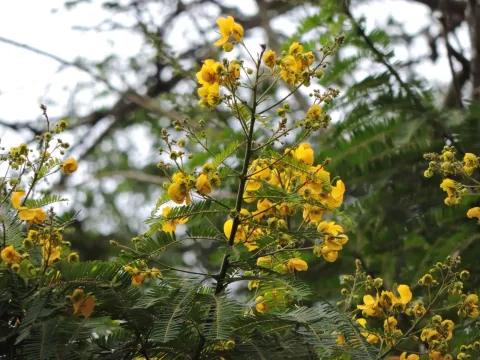
Senna multijuga
Senna multijuga
Sowing of Senna multijuga seeds is best performed after scarification to break physical dormancy and improve germination rates significantly.
What the section contains
Senna multijuga
Seeds are typically sown in a well-draining nursery mix, keeping the soil consistently moist until germination occurs after about two weeks.
The ideal planting density depends on the purpose of the plantation, with wide spacing recommended for timber production or agroforestry systems.
For direct seeding, it is essential to clear competing weeds, as young seedlings are sensitive to resource competition during their initial growth phase.
Greenhouse propagation allows for faster growth and higher survival rates before transplanting the saplings to the field environment.
Senna multijuga is a deciduous or semi-evergreen tree belonging to the Fabaceae family, prized for its rapid growth and abundant yellow flowers.
It thrives in full sunlight and is known for its high adaptability to varying soil types, showing robustness even in depleted or degraded landscapes.
The species prefers tropical and subtropical climates where it can fully express its potential, though it tolerates moderate dry seasons remarkably well.
As a legume, it contributes to soil fertility by fixing atmospheric nitrogen, making it a valuable species for reforestation and environmental restoration projects.
Water requirements are relatively low once the tree is established, making it a sustainable choice for landscaping and erosion control in arid areas.
Harvesting for medicinal or ornamental purposes involves periodic pruning of the branches to maintain the tree's health and aesthetic shape.
The seeds can be collected once the pods turn brown and start to dry on the tree, signaling full maturation of the reproductive parts.
Wood harvesting, if managed within a forestry rotation, is done manually using standard tools, ensuring that the main trunk remains intact for future growth.
Collection of floral biomass for extract processing is performed during the peak flowering season when the concentration of beneficial compounds is highest.
Post-harvest processing should be done in a dry, ventilated area to prevent mold growth on seeds or plant materials intended for further usage.
Root rot caused by Oomycetes or soil-borne fungi is the most critical threat when the tree is planted in heavy, waterlogged soils.
Defoliating insects can occasionally cause aesthetic damage, though mature, healthy trees are generally resilient to such infestations.
Leaf spot diseases may appear during seasons of prolonged rainfall, potentially reducing the photosynthetic capacity of the canopy.
Scale insects and aphids are minor threats that rarely reach levels necessitating chemical intervention in established plantations.
Integrated pest management strategies focusing on promoting local natural predators are highly effective for managing Senna multijuga health.