
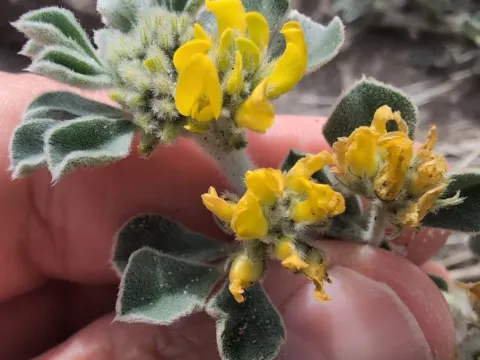
Sea medick
Medicago marina
Sea medick (Medicago marina) is a perennial member of the Fabaceae family, highly adapted to saline coastal environments. It is characterized by dense, white, felt-like hairs covering its stems and leaves, which serve as a physiological adaptation to arid, salty, and windy seaside conditions.
What the section contains
Sea medick
This species naturally inhabits sandy dunes and coastal beaches. Its botanical structure includes small, rounded leaves and yellow flowers, which are typical of the Medicago genus, though the overall habit is prostrate or creeping rather than upright.
Regarding climatic requirements, Sea medick thrives in temperate and Mediterranean-like conditions. It is extremely heliophilic and requires full solar exposure to maintain its metabolic functions and prevent etiolation or fungal infections.
Soil requirements are highly specific; the plant mandates well-drained, sandy, and saline substrates. It possesses a deep rooting system that allows it to access water deep within dunes, making it an excellent candidate for sand stabilization efforts.
Unlike standard alfalfa crops used for livestock feed, Sea medick is primarily valued for its role as a pioneer species in ecological restoration and coastal defense. It plays a critical role in preventing soil erosion in fragile shoreline ecosystems.
The primary threat to Sea medick is the presence of fungal pathogens, particularly powdery mildew, which develops rapidly in environments with poor air circulation. High relative humidity is generally detrimental to the health of this species.
Pests known to affect other Medicago species, such as weevils and aphids, may occasionally infest Sea medick. However, the plant's thick indumentum acts as a mechanical barrier that deters many common insects, providing a degree of natural resistance.
Root system damage due to soil compaction or excessive human traffic poses a significant threat to its survival. Because the plant relies on a delicate balance between sand stability and symbiotic nitrogen fixation, soil disturbance must be minimized.
Waterlogging is a major physiological threat that quickly leads to root hypoxia. If the plant is cultivated outside of its preferred sandy habitat, the risk of anaerobic soil conditions increases significantly, causing rapid decline.
Maintenance of healthy stands requires careful management of plant spacing to ensure optimal airflow. Integrated pest management, avoiding synthetic chemical inputs, is usually sufficient to control the limited range of biotic threats faced by this coastal plant.