
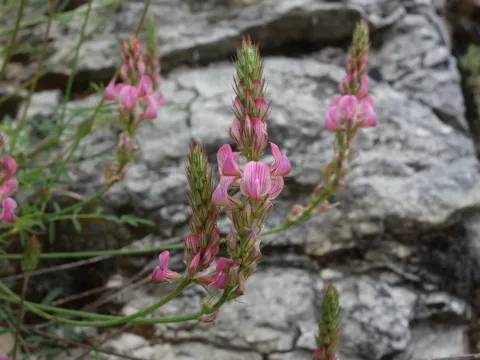
Spiny sainfoin
Onobrychis supina
Spiny sainfoin (Onobrychis supina) is a perennial legume that is typically sown in early spring when soil temperatures reach 5-8 degrees Celsius. Early establishment is crucial for the seedlings to develop a deep root system before the onset of summer heat.
What the section contains
Spiny sainfoin
The seeding rate varies from 60 to 100 kg per hectare, depending on soil conditions and the intended use of the crop. Standard row spacing of 15 cm is generally recommended to ensure a uniform canopy and to help the crop outcompete weeds during its initial growth phase.
Seeds should be planted at a depth of 2-4 cm. Proper depth placement is essential to balance the need for moisture retention in the soil with the ability of the seedling to emerge quickly without exhausting its energy reserves.
Post-sowing rolling is a standard practice to improve seed-to-soil contact, which increases germination rates. By firming the soil, producers can enhance capillary water movement, providing a more stable environment for the young sprouts during the establishment year.
In arid regions, planting in wider rows can be beneficial to manage moisture competition. While this might lead to slightly lower total biomass per hectare, it ensures the long-term survival of the stand in climates where water is the limiting factor for growth.
This crop is highly prized for its exceptional drought tolerance, a trait attributed to its deep, woody taproot system. It thrives in regions where other forage legumes might struggle, making it an excellent candidate for semi-arid agricultural landscapes.
Spiny sainfoin has a strict preference for alkaline, calcareous soils. It performs best in soils with a pH ranging from 7.0 to 8.0. It is poorly suited for acidic, waterlogged, or heavy clay soils, where plant vigor and longevity significantly decrease.
Sunlight exposure is a major driver of yield for this species. It is a light-demanding plant, and productivity is maximized when grown in open fields or on southern-facing slopes. Shady conditions result in stunted growth and increased susceptibility to disease.
The plant is sensitive to high water tables. Waterlogging can quickly lead to root rot, which is a common cause of stand failure in improperly selected fields. Well-drained soils are therefore a mandatory requirement for sustainable production.
Temperature-wise, the plant is adaptable to continental climates with wide temperature fluctuations. However, it requires protection from severe frost if there is no snow cover. In most temperate regions, it is considered a hardy and reliable forage crop.
The yield of Spiny sainfoin typically ranges from 15 to 30 tons of green mass per hectare per year. Productivity peaks during the second and third years of establishment as the plants mature and maximize their root penetration and canopy spread.
Nutritionally, the forage is high in protein, minerals, and soluble carbohydrates. Unlike alfalfa, it does not cause bloat in ruminants, making it a safer and highly desirable pasture option for sheep and cattle grazing during the growing season.
The crop demonstrates strong regrowth capabilities. Under favorable moisture conditions, two to three cuts per season can be achieved. This high turnover makes it a productive choice for livestock farms looking to maximize their fodder output.
Seed production is another viable economic activity for this crop, yielding 3-6 quintals per hectare. Proper management during the flowering and ripening phases is necessary to prevent pre-harvest loss caused by natural seed shattering.
Fertilization with phosphorus and potassium is recommended to sustain long-term yields. Because it establishes a symbiotic relationship with nitrogen-fixing bacteria, the need for synthetic nitrogen fertilizers is typically very low, benefiting soil health.
The primary diseases affecting this crop are Fusarium wilt and powdery mildew, which thrive in humid conditions. Implementing a crop rotation strategy that separates legume cycles by at least 4-5 years is the most effective way to minimize these risks.
Root-feeding insects, such as clover root curculios, can cause significant damage to young stands. If left unchecked, these pests can weaken the root system, making the plants more vulnerable to environmental stress and opportunistic pathogens.
The sainfoin seed chalcid is a specific pest that targets the reproductive organs, potentially destroying a large portion of the seed harvest. Control measures involve timely chemical applications during the flowering period, coordinated to avoid harm to pollinators.
Bacterial blight can also cause foliage loss, impacting the quality of the harvested hay. Managing the stand density and ensuring adequate airflow helps reduce the incidence of blight, allowing the plant to maintain its leaf integrity for longer periods.
While invasive weeds are a threat in the first year, the establishment of a dense, vigorous stand of Spiny sainfoin is usually sufficient to suppress most weeds in subsequent years without the need for intensive herbicide usage.
Harvesting for hay is best performed at the full-bloom stage. This timing captures the optimal balance between biomass volume and nutritional quality, ensuring that the forage is rich in digestible energy and essential vitamins for livestock.
To produce high-quality hay, the cut material should be left to wilt in the field for 24-48 hours. After this period, it should be raked into windrows. Quick drying preserves the green color and nutritional integrity, which are key indicators of quality hay.
For green-chop feeding, harvesting should begin at the early flowering stage. At this phase, the plant has the highest moisture and sugar content, making it highly palatable and efficient for milk production in dairy herds.
When harvesting for seeds, a two-phase method is preferred: swathing followed by picking up the material for threshing. This helps reduce seed loss from shattering, which occurs naturally as the pods reach full physiological maturity.
It is important to end the harvesting season at least one month before the first frost. This allows the plants to translocate carbohydrates down to the roots, which is essential for surviving the winter and ensuring rapid regrowth in the following spring.