
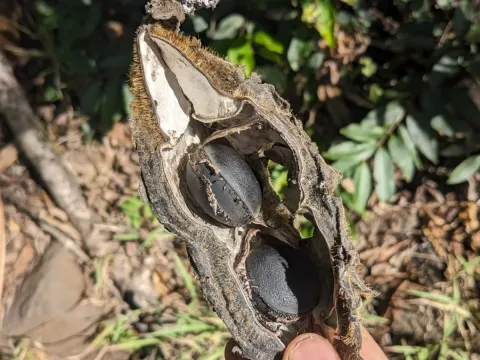
Mucuna sloanei
Mucuna sloanei
Sowing of Mucuna sloanei is typically initiated at the beginning of the rainy season when soil temperatures are consistently above 22 degrees Celsius. This ensures optimal germination and establishment.
What the section contains
Mucuna sloanei
Seeds are sown at a depth of 3 to 5 centimeters. Proper spacing between rows is critical to manage the vigorous growth and to prevent excessive competition between developing seedlings.
Due to the tough seed coat, scarification may be beneficial in commercial settings to improve water uptake and promote faster germination rates across the planting field.
When used in agroforestry systems, seeds are often sown under the canopy of established perennial crops. This allows the climbing vine to utilize existing structures for vertical growth.
Farmers should avoid sowing during extended dry periods unless irrigation can be guaranteed, as the early seedling stage is sensitive to moisture stress and high temperatures.
As a member of the Fabaceae family, Mucuna sloanei thrives in humid tropical environments. It prefers well-drained loamy or sandy soils with a neutral to slightly acidic pH level.
The plant requires ample sunlight for vigorous growth, although it shows good tolerance to moderate shade. This adaptability makes it suitable for intercropping with other agricultural species.
The ideal temperature for vegetative development ranges from 25 to 30 degrees Celsius. The crop is highly frost-sensitive, and exposure to cold temperatures will lead to immediate tissue damage.
Vertical support is essential for the plant to reach its full productive potential. Without structures to climb, the vine will spread along the ground, which may reduce its overall biomass yield.
The crop possesses a deep and efficient root system, allowing it to withstand brief periods of drought, though consistent rainfall is preferred for the best agricultural performance.
Mucuna sloanei is prized for its high biomass production, making it an excellent candidate for green manure. It can produce massive amounts of organic matter per hectare annually.
Seed yield varies depending on local pollinator activity. In favorable conditions, individual plants can produce a significant quantity of seeds suitable for future propagation and distribution.
The primary economic value of the crop is its ability to fix atmospheric nitrogen. This helps restore degraded soils and provides a sustainable alternative to commercial nitrogen fertilizers.
The accumulation of plant residues significantly improves soil structure and fertility, resulting in higher yields for subsequent food crops planted in the rotation cycle.
Management of the biomass is crucial; if not properly controlled, the rapid growth rate can lead to the vine overwhelming other nearby crops or becoming difficult to clear.
Mucuna sloanei is relatively resistant to common pests due to secondary metabolites present in its leaves. This natural chemical defense reduces the need for synthetic insecticide applications.
In highly humid conditions, the plant may face pressure from fungal diseases such as anthracnose or various root rots, particularly if soil drainage is suboptimal or airflow is restricted.
Nematodes can pose a challenge by affecting root nodules, which in turn impairs the plant's nitrogen-fixing capacity. Proper crop rotation is recommended to prevent the buildup of soil-borne pathogens.
Leaf-eating insects can cause cosmetic damage, but the plant's aggressive growth rate usually allows it to recover quickly without significant loss of productivity or vigor.
The main concern for farmers is the invasive potential of the plant. It requires consistent monitoring to prevent it from spreading into areas where its vigorous climbing habit is unwanted.
Harvesting of the pods is performed manually as they reach maturity. Timing is essential, as the pods tend to shatter upon drying, which can cause seeds to disperse prematurely into the field.
When cultivated for soil improvement, the crop is typically incorporated into the soil during the flowering stage to maximize the nutrient content before the seeds have fully developed.
For fodder production, the vine is harvested before the stems become overly lignified. This ensures the best nutritional quality and palatability for livestock consumption.
Harvested seeds must be dried thoroughly in shaded conditions to prevent fungal growth. Storage should occur in cool, dry areas to maintain high seed viability for the following season.
Using the harvested vine residues as mulch is a common practice that helps maintain soil moisture levels and protects the land from erosion during the intense tropical sun.