
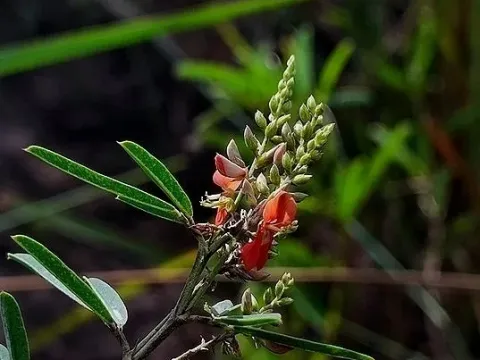
Indigofera lespedezioides
Indigofera lespedezioides
Indigofera lespedezioides is a leguminous plant (Fabaceae family) that is gaining interest for its role in soil improvement and fodder production. Sowing should ideally occur when soil temperatures reach 18–20 degrees Celsius.
What the section contains
Indigofera lespedezioides
Standard row planting with spacing between 30 and 45 centimeters is recommended for optimal canopy development. Due to the hard seed coat, scarification is necessary to ensure uniform germination.
Seeds should be planted at a shallow depth of 1 to 2 centimeters. Ensuring proper soil moisture immediately after planting is crucial to support early development.
The seedling stage is characterized by slow initial growth. Regular weeding during the first few weeks is essential to prevent weed competition from hindering the crop's establishment.
Seeding density should be adjusted based on the objective, with higher densities being more effective for green manure production and lower densities for seed multiplication.
This species is well-adapted to tropical and subtropical climates. It thrives under high solar radiation and consistent temperatures typical of its native range.
One of the key agronomic advantages of Indigofera lespedezioides is its ability to grow in poor, acidic, and sandy soils where other crops struggle.
The plant exhibits excellent drought tolerance. Its deep root system allows it to reach water reserves that are inaccessible to many shallow-rooted forage crops.
Proper drainage is a vital requirement, as the plant does not tolerate waterlogging. It is best suited for well-drained, porous soil environments.
As a nitrogen-fixing legume, it significantly contributes to soil fertility. It establishes symbiotic relationships with root bacteria that convert atmospheric nitrogen into plant-available forms.
Yields of biomass depend significantly on local rainfall patterns and soil management practices, often producing robust growth in high-precipitation environments.
As a forage crop, it provides high-quality nutrition for livestock, containing a balanced profile of protein and essential minerals for animal health.
When used as a green manure, the crop can be incorporated into the soil, providing a substantial amount of organic nitrogen and improving soil structure.
Seed yield is reliable under favorable management, allowing for steady propagation and consistent availability of high-quality seeds for agricultural programs.
The long growing season allows for multiple harvests per year in warm climates, making it a productive component of sustainable livestock and cropping systems.
Indigofera species are generally robust and possess natural chemical defenses, making them naturally resistant to a wide range of common agricultural pests.
Root rot is the most common threat, usually triggered by excessive moisture or poor field drainage. This can lead to significant stand depletion.
Leaf-eating insects may affect younger plants, though damage is rarely fatal unless the infestation levels are extremely high during early growth stages.
Nematode infestations can occur, especially if the crop is grown continuously on the same land, which necessitates careful crop rotation management.
- Implement long-term crop rotation.
- Ensure fields have adequate drainage.
- Monitor early developmental stages for signs of insect pressure.
Harvesting for green forage or biomass should take place during the peak flowering stage to capture the highest nutrient concentration within the leaves and stems.
For seed production, the harvest should be timed carefully once the seed pods show a mature brown color to avoid excessive shattering in the field.
Mechanical harvesting is feasible using standard equipment with adjustments for the specific height and density of the mature stand.
Harvested biomass can be processed into silage or dried for hay, providing a reliable reserve of high-protein feed for dry-season livestock maintenance.
Post-harvest residues are highly beneficial and should be incorporated back into the soil to serve as organic matter and nitrogen fertilizer for subsequent crops.