
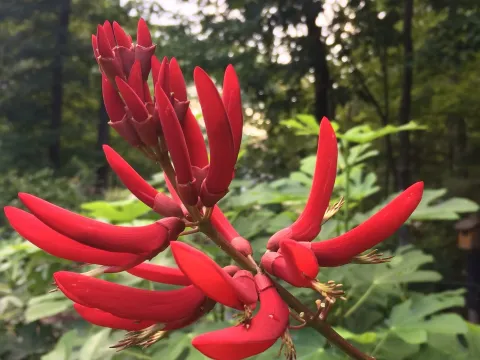
Erythrina bidwillii
Erythrina bidwillii
Erythrina bidwillii is an ornamental deciduous shrub belonging to the Fabaceae family, widely recognized as a cross between Erythrina herbacea and Erythrina crista-galli. It is cherished for its vivid, deep red, tubular flowers that bloom on long racemes.
What the section contains
Erythrina bidwillii
While the parent species are native to tropical and subtropical areas of the Americas, this hybrid is well-adapted to cultivated garden settings in warm climates. It generally thrives in USDA zones 8–10, where it acts as a resilient perennial.
The cultivation of this plant requires a location with full, direct sunlight to ensure vigorous flowering. Lack of light often results in leggy growth and significantly reduced blooming performance throughout the summer months.
Soil quality is paramount; the plant demands well-draining, nutrient-rich soil to prevent root rot. In heavy clay soils, it is strongly recommended to incorporate organic matter and sand to improve aeration and drainage properties.
Agrotechnical maintenance includes consistent watering during the growing season and periodic fertilization with a balanced, phosphorus-heavy fertilizer to promote flower development. Pruning should be done after the flowering period to encourage branching.
Common pests affecting Erythrina bidwillii include spider mites, which thrive in hot and dry conditions. Infestations manifest as webbing and discolored foliage, requiring prompt treatment with horticultural oils or miticides.
Aphids are frequent visitors that target tender new shoots, causing stunted growth and leaf curling. Integrated pest management using soaps or systemic insecticides is effective in keeping populations under control.
Root rot, primarily caused by Phytophthora or Pythium species, remains the most significant threat to the plant's survival. This is almost always triggered by overwatering or poorly drained substrates.
Whiteflies can become a nuisance, especially in greenhouse environments or sheltered garden spots with poor air circulation. They weaken the plant by extracting sap and spreading viral infections.
Scale insects present a hidden threat by attaching themselves to the stems and branches. Their presence often goes unnoticed until the plant shows signs of decline, necessitating the use of specialized systemic insecticides for eradication.