
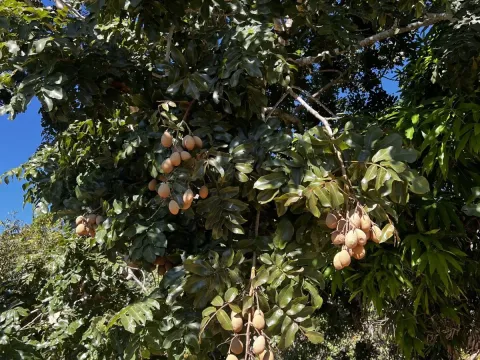
Dipteryx alata
Dipteryx alata
Propagation of Dipteryx alata is primarily performed through seeds. The seeds possess a thick, resistant endocarp that often requires mechanical scarification to improve water absorption and significantly decrease the time required for successful germination.
What the section contains
Dipteryx alata
Sowing should be conducted in well-drained nursery containers or dedicated seedbeds. It is essential to maintain a constant substrate moisture level and a warm environment, ideally with temperatures around 25 degrees Celsius, to support healthy seedling emergence.
Transplanting into the permanent field should be synchronized with the onset of the rainy season. Natural precipitation facilitates root system establishment without the need for intensive artificial irrigation, helping the young trees cope with transplantation shock.
For orchard spacing, a distance of 8 to 10 meters between trees is recommended. This layout ensures that each tree has sufficient space for canopy development, reducing competition for sunlight and essential nutrients as the trees mature.
Young saplings are vulnerable to intense solar radiation. Providing temporary shade covers during the first few months in the field significantly improves survival rates and promotes stronger initial vegetative growth before the trees become fully acclimatized.
Dipteryx alata is a legume species native to the tropical savannahs. It is well-adapted to environments characterized by a distinct seasonality, specifically long dry periods followed by intense rainy seasons, which define the growth cycle of the tree.
The species performs best in deep, well-drained soils. While it exhibits high tolerance for poor nutrient conditions typical of its native range, avoiding waterlogging is crucial, as the root system is sensitive to low-oxygen soil environments.
The optimal temperature range for this species is between 22 and 30 degrees Celsius. Its deep taproot allows the tree to access groundwater reservoirs during extended droughts, demonstrating remarkable resilience and efficiency in challenging tropical conditions.
A successful yield requires an annual rainfall range of approximately 1200 to 1800 millimeters. Protection from strong, persistent winds is advisable, especially for young orchards, as wind damage can lead to structural issues and decreased growth rates.
As a light-demanding species, Dipteryx alata requires full sun exposure for peak performance. Areas with heavy shading should be avoided, as restricted access to light will significantly reduce photosynthetic activity and long-term fruit production.
The productive phase of Dipteryx alata typically begins between 7 and 10 years after planting. This slow maturity is common among many leguminous tree species and requires a long-term approach to orchard management and investment planning.
An average mature tree yields between 10 to 30 kilograms of fruit annually. The fruits are drupes containing highly nutritious seeds that are rich in proteins, essential fatty acids, and various minerals, making them a high-value agricultural product.
Factors influencing annual yields include pollination efficiency and the local climatic conditions during the flowering stage. Adverse weather, such as heavy rains during the flowering period, can disrupt pollinators and reduce the overall fruit set.
Economic potential lies in the extraction of high-quality vegetable oils and the use of the kernel in food applications. Its versatility allows farmers to diversify their income sources, making it a sustainable choice for tropical agricultural projects.
Maintaining consistent yield requires periodic monitoring and tree care. Providing optimal growing conditions and managing soil fertility can help stabilize production, ensuring that the orchard remains profitable over several decades of operation.
The primary threats to Dipteryx alata include fungal infections, which target the leaves and stems in high-humidity environments. These pathogens can cause significant leaf spot disease, leading to premature defoliation and weakening the overall vigor of the trees.
Insect pests pose a substantial risk, particularly to the developing fruits. Careful monitoring for signs of infestation is required to prevent larvae from damaging the seeds, which are the main commercial value of the crop, necessitating proactive control measures.
Integrated pest management (IPM) is the most effective approach for this species. This involves combining biological controls, such as encouraging local insect predators, with regular pruning to improve airflow and reduce the humidity around the crown.
Sanitation pruning is vital to mitigate disease spread. By removing dead or diseased branches and thinning the canopy, growers can create an environment that is less conducive to the growth of harmful bacteria and fungal spores.
Regular orchard inspections are critical for early detection. Promptly addressing potential disease hotspots through isolation or specialized treatment ensures that infections do not spread across the plantation, protecting the overall annual harvest.
Harvesting Dipteryx alata involves the systematic collection of fruits that have fallen to the ground. This process requires frequent orchard visits during the ripening season, as fruits left on the moist soil surface quickly degrade in quality.
Immediate primary processing is necessary post-harvest. The outer fleshy pulp should be removed—often serving as organic waste or fodder—while the solid endocarp containing the seed must be dried thoroughly to reach 7–9 percent moisture content.
Proper drying is the most critical step for shelf-life extension. Reducing moisture content prevents mold development, which can introduce dangerous mycotoxins and cause rapid spoilage, rendering the seeds unsuitable for human consumption or oil extraction.
Although mechanical harvesting is currently limited by topography and variable ripening times, manual harvesting remains the standard. This method ensures that the product is handled carefully, preserving the integrity and quality of the seeds.
Efficient logistics from the orchard to the processing facility is key to maximizing quality. Minimizing the time between fruit collection and final storage ensures that the market value of the product is fully maintained for subsequent commercial use.