
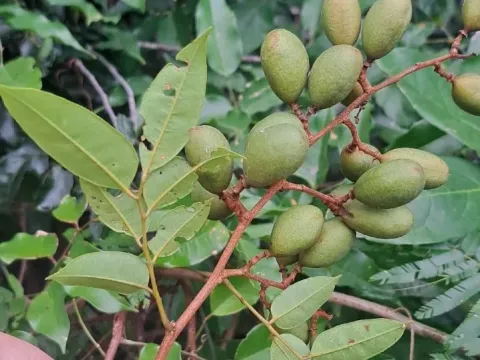
Dialium guianense
Dialium guianense
Dialium guianense is a prominent tropical tree species belonging to the Fabaceae family. Known for its robust growth and impressive stature, this tree can reach significant heights, making it a key structural element in the rainforest canopy throughout Central and South America.
What the section contains
Dialium guianense
The tree is primarily found in tropical rainforest environments where precipitation is abundant throughout the year. Its natural distribution is widespread, covering various regions across the Neotropics, where it thrives in temperatures that remain consistently warm and stable.
When it comes to edaphic requirements, Dialium guianense prefers deep, well-drained soils. While it can adapt to various soil types, it performs best in environments that provide a balance of organic matter and moisture, avoiding areas prone to waterlogging or anaerobic conditions.
A crucial biological adaptation of this species is its association with nitrogen-fixing bacteria in its root system. This capability not only allows the tree to thrive in nutrient-deficient forest soils but also plays a vital role in natural forest regeneration by enriching the substrate for surrounding vegetation.
Regarding light, while juvenile trees are shade-tolerant and often grow under the dense canopy, mature specimens require high levels of solar exposure to maintain optimal physiological activity. This transition in light requirements is typical for many long-lived hardwood species in tropical ecosystems.
The timber of Dialium guianense is highly prized for its exceptional mechanical properties, particularly its hardness and density. Due to its resistance to fungal decay and insect damage, it is a preferred material for heavy-duty construction, high-end cabinetry, and specialized industrial woodwork.
The fruits of the tree are also economically and nutritionally significant. They are characterized by a sweet and tangy pulp that is widely harvested by local populations. This pulp is consumed fresh or used in various culinary applications, such as beverages and artisanal food products.
Sustainable harvesting remains a top priority for this species. Given its relatively slow growth rate, forest management plans must emphasize long-term cycles of growth and selection, ensuring that harvest rates do not exceed the natural replenishment capacity of the population.
Medicinal properties are another area of interest regarding this tree. Ethnobotanical studies have documented the use of its bark and leaves in traditional medicine to address various health concerns, suggesting that the plant holds potential for future biochemical and pharmaceutical research.
Integrating Dialium guianense into agroforestry systems provides multiple benefits. Beyond the production of timber and edible fruit, these trees act as carbon sinks and help maintain local biodiversity, proving that economic development and environmental conservation can proceed in tandem.