
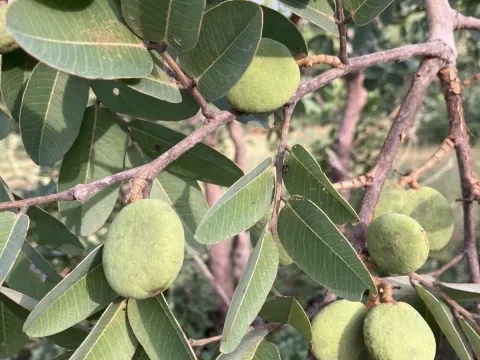
Detarium
Detarium
Propagation of Detarium in natural conditions occurs mainly through seeds, which exhibit high germination rates under tropical climate conditions. Sowing is typically carried out at the beginning of the rainy season when soil moisture optimally supports the germination of the seed's hard coat.
What the section contains


Detarium
For establishing forest plantations, seeds are sown in prepared nurseries or directly into the soil at a depth of 3–5 cm. It is crucial to ensure regular substrate moisture during the first weeks post-sowing, as young seedlings are sensitive to dry spells.
In commercial cultivation, scarification of the seeds is recommended to accelerate germination. The optimal soil temperature for the initiation of root system development is between +25°C and +28°C.
Site selection for planting requires consideration of stand density: Detarium is a large tree, therefore at least 8–10 meters of free space must be left between individual plants.
Young seedlings require protection from direct, intense sunlight during their first months of life; thus, planting under the canopy of other fast-growing trees is a common practice.
Detarium belongs to the Fabaceae family and is an evergreen tropical tree primarily distributed in the forested zones of West and Central Africa.
The culture prefers deep, well-drained sandy or loamy soils with a neutral or slightly acidic pH, typical of tropical savannas and light woodlands.
The tree is extremely demanding regarding temperature: it cannot withstand even short-term frosts and requires consistently high temperatures throughout the growing season.
In its natural habitat, the plant has adapted to pronounced seasonal rainfall fluctuations; however, for stable fruiting, the tree requires an annual precipitation level of at least 1000–1200 mm.
From an agronomic perspective, Detarium is quite resilient to brief droughts due to a well-developed root system capable of extracting moisture from deep soil horizons.
The primary economic product of Detarium is its round drupe fruits, which have a sweet, floury pulp highly valued by local populations as a food resource.
The yield of a single mature tree can range from 50 to 150 kg of fruit per year, depending on the plant's age, soil quality, and the intensity of plantation management.
Peak fruiting occurs in the mature stage of the tree, and Detarium is capable of producing stable yields for several decades, making it a valuable species for agroforestry.
Fruits are harvested after natural abscission, which indicates full pulp maturity and an optimal sugar content suitable for processing.
Detarium wood also holds significant economic value: it is very strong, heavy, and resistant to decay, making it widely used in furniture manufacturing and construction.
The main threats to Detarium are fungal infections that affect the root system during periods of excessive water stagnation in the soil horizon during heavy rainfall.
Pests, such as weevils and various types of caterpillars, can cause significant damage to the fruit harvest by affecting ovaries and pulp directly on the tree branches.
Nutrient imbalance, particularly nitrogen deficiency in the soil, slows the growth of young seedlings, making them more vulnerable to adverse external environmental impacts.
Competition with weeds during the first years of growth can lead to the suppression of Detarium, making regular weeding of the tree basin an essential agricultural practice.
Large-scale anthropogenic factors, such as deforestation and climate change, pose the greatest systemic threat to the natural populations of this species in Africa.
Harvesting of Detarium is mainly carried out manually, as fruits do not ripen simultaneously and require careful handling to preserve their market quality.
Ripe fruits have a characteristic color and a firm skin that protects the internal pulp from damage upon impact with the leaf litter on the ground.
After collection, fruits are sorted by size and ripeness, cleaned of external dirt and pedicel residues, which is important for ensuring long-term storage.
To prevent spoilage during long-distance transportation, the harvest is dried in well-ventilated rooms to reduce pulp moisture to safe levels.
Processed Detarium pulp is often used for making flour, beverages, and various confectionery products, significantly expanding the market potential of the crop.