
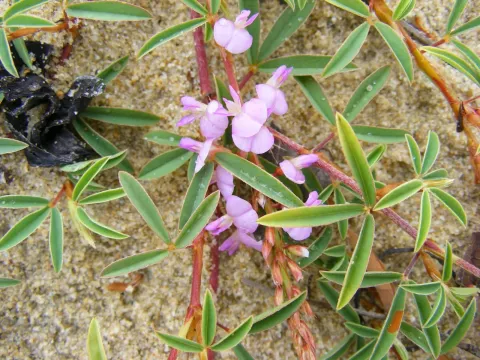
Desmodium biarticulatum
Desmodium biarticulatum
Desmodium biarticulatum is a perennial legume species primarily cultivated in tropical regions. Sowing usually coincides with the onset of the rainy season to ensure sufficient moisture for seed germination and initial establishment.
What the section contains
Desmodium biarticulatum
The seeds should be sown shallowly, ideally no deeper than 1–2 centimeters, to facilitate rapid emergence. Proper seedbed preparation is essential to eliminate weed competition during the early growth stages.
Seed scarification is often recommended to overcome dormancy issues and improve the uniformity of germination. This process allows moisture to penetrate the hard seed coat more effectively under field conditions.
Sowing density must be calibrated to achieve a full stand coverage, which serves a dual purpose: suppressing invasive weeds and protecting the soil surface from the intense heat and heavy rainfall.
Inoculation with specific Rhizobium strains is a beneficial practice. It ensures effective nodulation and boosts the legume's ability to fix nitrogen from the atmosphere, reducing the need for chemical inputs.
This plant thrives in well-drained soils, showing a remarkable ability to adapt to various soil textures. However, it performs optimally in soils with neutral to slightly acidic pH and moderate fertility levels.
Full solar radiation is critical for the growth of Desmodium biarticulatum. It is highly sensitive to shade, and any level of canopy cover from trees or neighboring tall crops significantly reduces its biomass production.
The plant prefers tropical temperature regimes, ideally ranging from 24 to 30 degrees Celsius. Development slows significantly in cooler conditions, and exposure to frost will typically lead to plant death.
While established plants show some tolerance to drought, consistent rainfall is required for high-yield forage production. Prolonged dry spells during the vegetative stage can cause stunting and leaf shedding.
Nutrient management is essential, with an emphasis on phosphorus and potassium application. These nutrients are vital for root system health and the effectiveness of the symbiotic nitrogen-fixing process in the root nodules.
Desmodium biarticulatum is primarily used as a high-quality forage crop. Its nutritional profile, particularly the high crude protein content, makes it an excellent supplement for cattle, sheep, and goats.
Beyond its value as fodder, the crop is widely recognized for its role in soil conservation. It acts as an effective ground cover that prevents water-induced soil erosion on sloping terrains.
It is frequently incorporated into agroforestry systems as a green manure, improving soil structure and fertility through the accumulation of organic matter and natural nitrogen enrichment.
Yield capacity is highly dependent on management intensity. When managed with appropriate cutting cycles, the plant exhibits excellent regrowth potential, providing multiple harvests throughout a single growing season.
In addition to direct grazing or hay production, the biomass can be processed into silage, ensuring a reliable source of protein-rich feed during seasonal forage shortages in tropical cattle farming.
Foliar diseases, such as leaf spot fungi, are common threats during periods of high humidity. Proper field spacing to ensure adequate air circulation can significantly mitigate these risks.
Insect pests, including various leaf-eating beetles and caterpillars, can cause severe defoliation. Regular monitoring and, if necessary, the use of bio-rational pesticides are recommended for large-scale operations.
Nematode infestations in the root zone can be particularly problematic in sandy soils, leading to overall plant decline and susceptibility to secondary infections or environmental stress.
Overgrazing poses a major threat, as it exhausts the plant's carbohydrate reserves. Maintaining a rest period between utilization cycles is essential for preserving the long-term health and productivity of the sward.
Implementing a robust integrated pest management (IPM) strategy, including crop rotation and the selection of vigorous plant varieties, is the best approach to maintain sustainable production levels.
Harvesting for hay should ideally occur at the peak of the flowering stage, as this is when the balance of structural carbohydrates and protein content is most favorable for livestock nutrition.
Mechanical harvesting requires careful setting of the cutting height. Leaving sufficient stubble (5–10 cm) is crucial to allow the plant to regenerate quickly from the dormant buds located at the base of the stems.
Post-harvest handling is critical to preserve the nutritional value of the leaves. Drying should be conducted with minimal disturbance to prevent shattering and loss of the leaf fraction, which is the most nutritious part.
During the harvest of seed material, low-impact harvesting methods are preferred to minimize seed damage. Given the seed's characteristics, gentle cleaning and drying processes are required for high-quality storage.
Strategic management of harvest times relative to weather patterns is vital to minimize losses. Planning harvests before intense weather events ensures the quality of the preserved forage is maintained for winter or dry season use.